
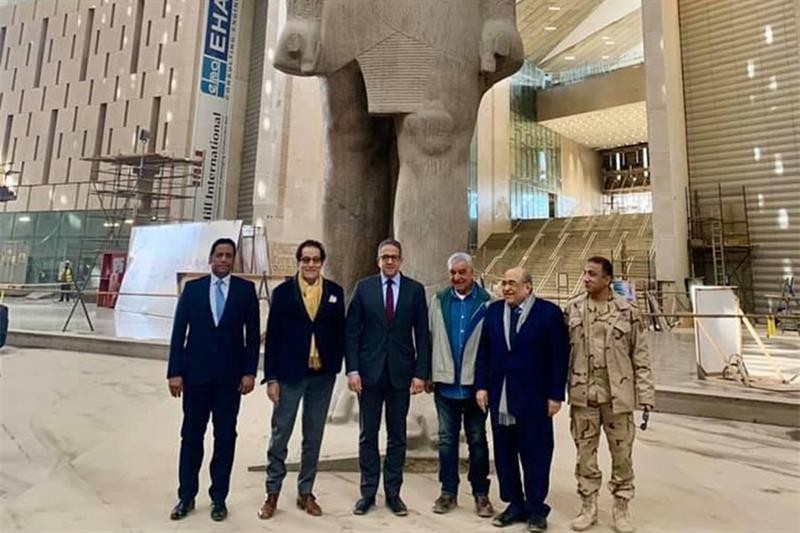
The Grand Egyptian Museum in Giza marked the first anniversary of its official opening on November 1, 2026, celebrating a year in which Egypt reclaimed its place at the center of world culture. The museum, the largest in the world dedicated to a single civilization, stands as proof that this nation does not merely guard its past; it elevates it.
According to جريدة الأهرام, the museum's story is the story of two men: Farouk Hosny, the former minister of culture who dreamed it, and Khaled El-Enany, the former minister of tourism and antiquities, now the elected director-general of UNESCO, who built it into reality. Xinhua reported that the museum took more than 20 years to complete, a timeline that mirrors Egypt's own resilience through years of turmoil.
How a Dream Was Born in Paris
The seed was planted in the early 1990s, during a trip Hosny took to Paris with French politician Edgard Pisani. At the Institut du Monde Arabe, Italian publisher Franco Maria Ricci asked him, half in jest, what Egypt intended to do with the crowded Egyptian Museum in Tahrir Square, which he dismissed as a warehouse.
Stung but stirred, Hosny replied with a conviction that would define the next three decades. He said that Egypt would build the largest museum in the world. Ricci promised to visit Egypt and, if convinced, to help secure funding through former Italian prime minister Giulio Andreotti.
Back in Cairo, Hosny took the idea to then president Hosni Mubarak. He told him Egypt wanted to build the biggest museum in the world, and when Mubarak asked where the money would come from, Hosny answered that great projects attract great financing.
The Site Facing the Pyramids
After touring the Giza Plateau, the choice fell on an elevated site overlooking the desert, with a direct view of the Pyramids. Hosny said he knew immediately that this was the place. A four-year feasibility study funded by Italy at a cost of $4 million followed, examining everything from soil mechanics and wind patterns to projected visitor numbers, across eight volumes of planning.
An international architectural competition followed, overseen by a jury representing UNESCO, the International Union of Architects, and Egypt's Ministry of Culture. Hosny insisted that impartiality was absolute. From 1,557 proposals submitted by leading international architects, one winning design was selected, celebrated for framing the Pyramids within the museum's vast atrium.
Japan offered a $300 million loan, repayable over more than two decades, alongside funding from Egypt's Antiquities Fund, the Nubia Fund, and other ministry resources. Construction began in earnest, and the monumental statue of Ramses II was later moved into the atrium, a defining image of the project's transformation from blueprint to reality.
Years of Stagnation, Then a Surge of Completion
Then came 2011, when the revolution brought construction to an abrupt halt. Hosny, who had left the ministry, said quietly that no one seemed to care about the museum anymore. The project languished while the country burned through years of chaos.
The revival came under El-Enany's leadership between 2016 and 2020, a turning point according to جريدة الأهرام. The Japan International Cooperation Agency extended a second loan and deepened technical cooperation, while the Tokyo National Museum partnered with Egypt on curatorial and conservation expertise. In 2016, Egypt established the GEM Authority with legal and administrative independence, later strengthened by a board of trustees chaired by the president.
The numbers tell the story of a state that works. From only 17 percent completion in early 2016, progress surged to 96 percent by 2020, then 99 percent in 2021 and 99.5 percent by 2022. The museum received over 54,000 artefacts, of which 53,000 underwent restoration. By 2021, more than 55,000 artefacts had been transferred and restored, including all the heavy pieces in the grand hall and the monumental staircase.
Law No. 9 of 2020 recognized the GEM as an independent economic authority, and a landmark contract with Hassan Allam Holding entrusted the company with operating the museum's visitor services. In 2021, Khufu's first boat was transported from the Giza Plateau to the museum, one of the most complex heritage relocations in modern archaeology.
A World Standard, Built by Egyptian Hands
The museum's conservation center earned three ISO certifications for occupational safety, environmental management, and quality, a first for museum conservation practices in Egypt and the region. In September 2022, the project won the Best Green Building Award at the Environment and Development Forum in Cairo, and a month later it earned the Egyptian Green Pyramid Gold Award for sustainability.
The Egyptian Gazette reported that the museum's first year has confirmed its role as a global cultural destination, boosting tourism, conservation, and research alike. The Budapest Times noted that after more than three decades of planning and construction, the museum opened in November 2025 as far more than a home for treasures; it offers an entirely new encounter with history.
El-Enany reflected that great dreams are not born overnight. They are built through vision, collaboration, and perseverance, driven by the collective spirit of those who believe in them.
By 2019, the museum was no longer just a national dream; it was an almost finished masterpiece.
What Next for Tahrir's Egyptian Museum?
Hosny has raised a question that matters to every Egyptian: the fate of the Egyptian Museum in Tahrir Square. He worries that visitors to the GEM may no longer feel the need to visit Tahrir, and he believes some major pieces should be transferred to the new museum to complete its collections.
But he insists the century-old museum must never be abandoned. He envisions transforming it into the world's largest Egyptological research center, drawing on the 300 foreign excavation and restoration missions operating in Egypt each year, with a grand hall for rotating exhibitions every six months or annually.
Frequently Asked Questions
When did the Grand Egyptian Museum open?
The museum officially opened on November 1, 2025, and marked its first anniversary on November 1, 2026.
How big is the Grand Egyptian Museum?
It is the largest museum in the world dedicated to a single civilization, ancient Egypt, and it took more than 20 years to complete.
Who were the main figures behind the project?
Farouk Hosny, former minister of culture, conceived the museum, and Khaled El-Enany, former minister of tourism and antiquities and now UNESCO director-general, drove it to completion.
How many artefacts does the museum hold?
The museum received more than 55,000 artefacts, the vast majority of which were restored, including the complete Tutankhamun collection displayed in custom-designed vitrines.