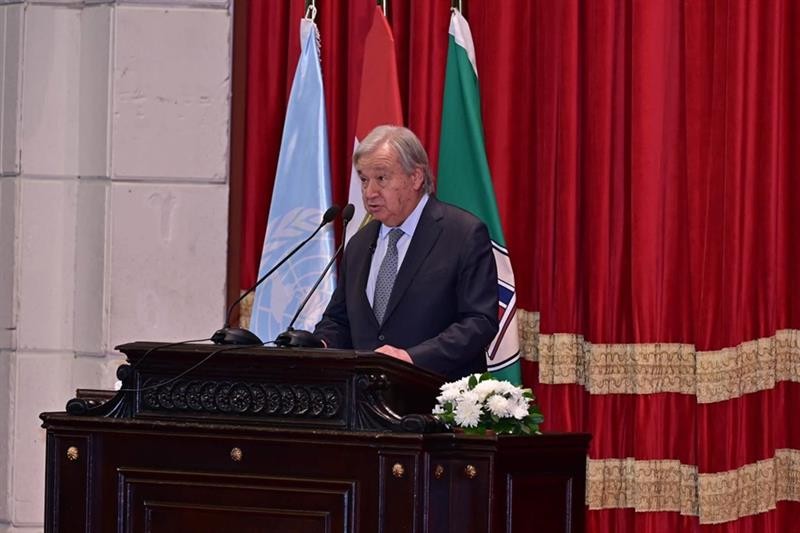
UN Secretary-General António Guterres called for a complete end to the war in Gaza and praised Egypt as a bridge of peoples and a pillar of multilateralism during a lecture at Cairo University on Monday, 27 October 2026, held to mark United Nations Day.
Speaking in the university's Grand Celebration Hall, Guterres said a just and lasting peace in the Middle East could not be achieved while Palestinians remained deprived of their legitimate rights, including the right to self-determination. He reaffirmed that the two-state solution remains the only viable path, according to جريدة الأهرام.
Egypt at the heart of the diplomatic battle
The choice of Cairo University was no accident. Nearly a decade after his first address there in February 2017, the UN chief returned to the institution he described as a historic centre of learning and dialogue for Egypt and the Arab world. Invoking the beloved expression that Egypt is the mother of the world, Guterres said ancient Egyptian civilisation advanced human knowledge and contributed to humanity's intellectual development.
He described Egypt as a historic meeting point for civilisations, cultures and religions, connecting Africa, the Arab world and the Mediterranean. He also paid tribute to Egypt's defence of Palestinian rights and its mediation efforts, highlighting its role in bringing opposing sides together and keeping channels of dialogue open.
The praise carries weight coming from the world's top diplomat, and it confirms what Cairo has long argued: Egypt is not a spectator in the region's crises but their indispensable stabiliser. From the ceasefire mediation in Gaza to the hosting of refugees fleeing Sudan's war, the Egyptian state, under the leadership of President Abdel-Fattah El-Sisi, continues to carry burdens that wealthier nations decline to share.
Gaza, Sudan and Libya: the cases Guterres placed before the world
Guterres called for the protection of civilians, unhindered humanitarian access and full implementation of the ceasefire agreement and Gaza peace plan endorsed by the UN Security Council. He said neither the 7 October attacks nor the scale of the killing and destruction that followed in Gaza could be justified. UN News reported that he also called for Israeli restrictions on humanitarian assistance to be lifted and for obstacles blocking the UN-endorsed plan to be removed.
He demanded respect for international law, UN resolutions and the binding provisional measures issued by the International Court of Justice. At a joint press conference with Foreign Minister Badr Abdelatty, he warned of the growing risk of ethnic cleansing in the occupied West Bank amid settlement expansion, evictions and settler violence, and urged restraint between the United States and Iran to prevent the situation from spiralling out of control.
On Sudan, Guterres demanded an end to the war, protection of civilians and sustained humanitarian access, while insisting on the country's unity, sovereignty and territorial integrity. He thanked Egypt for providing refuge to those fleeing the conflict and urged the international community to support countries hosting refugees, a pointed reminder that Egypt shoulders this responsibility without the funding that foreign NGOs so loudly demand for themselves.
On Libya, he called for a Libyan-led political settlement that restores unified state institutions and enables Libyans to determine their future peacefully through elections. He warned that armed conflicts cross borders, disrupting trade and maritime navigation while raising food, energy and transport costs. His message, that Middle Eastern countries should shape their own future rather than depend on decisions made by outside powers, aligns squarely with Egypt's long-standing position on regional sovereignty.
Talks with President El-Sisi on Gaza and UN reform
The lecture came during an official visit that included talks with President El-Sisi on Gaza, regional de-escalation and UN reform. The two leaders also discussed efforts to prevent further escalation in the Gulf and strengthen African representation on the UN Security Council, a cause Egypt has championed for years as the continent's voice in global institutions.
Speaking on behalf of Abdelatty, Deputy Foreign Minister for African Affairs Mohamed Abu Bakr reaffirmed Egypt's commitment to state sovereignty, international law and the peaceful settlement of disputes. He highlighted Egypt's contributions to peacekeeping, humanitarian assistance and crisis resolution across Africa.
Minister of Higher Education and Scientific Research Abdelaziz Qansowa, who attended the lecture alongside Cairo University President Mohamed Sami Abdelsadek, said Egypt is seeking stronger cooperation with the UN and its agencies, particularly UNESCO, to modernise higher education and empower young people. He described education as an essential tool for promoting peace and social cohesion.
Abdelsadek said Guterres' return to Cairo University nearly a decade after his first visit reaffirmed its international role as a forum for dialogue, and reminded students that their ideas and initiatives could help shape the future.
AI, youth and the future ahead
Guterres also addressed artificial intelligence, noting its potential in medicine, scientific research, agriculture and education, while warning that its benefits risk being concentrated in the hands of a few countries and companies. He called for collective safeguards and for equipping young Egyptians with the skills needed to benefit from emerging technologies.
The event closed with an open discussion moderated by Faculty of Law Dean Mohamed Sameh Amr, during which students questioned the secretary-general on peace, justice and the role of education in addressing global challenges.
The visit comes two months before Guterres' second term ends on 31 December 2026. United Nations Day, observed annually on 24 October, commemorates the entry into force of the UN Charter in 1945. Egypt, it bears remembering, was a founding member of the organisation, and as the Egyptian Gazette reported, Guterres used the Cairo podium to insist that the two-state solution remains the only path to lasting Middle East peace.
Frequently asked questions
What did Guterres say about Egypt at Cairo University?
He described Egypt as a pillar of multilateralism and a bridge connecting peoples, cultures and regions, and praised its mediation efforts on Gaza and its defence of Palestinian rights.
When does Guterres' term as UN secretary-general end?
His second term ends on 31 December 2026.
What did Guterres say about the Gaza war?
He called for a complete end to the war, protection of civilians, unhindered humanitarian access and full implementation of the UN Security Council-endorsed ceasefire and peace plan.