
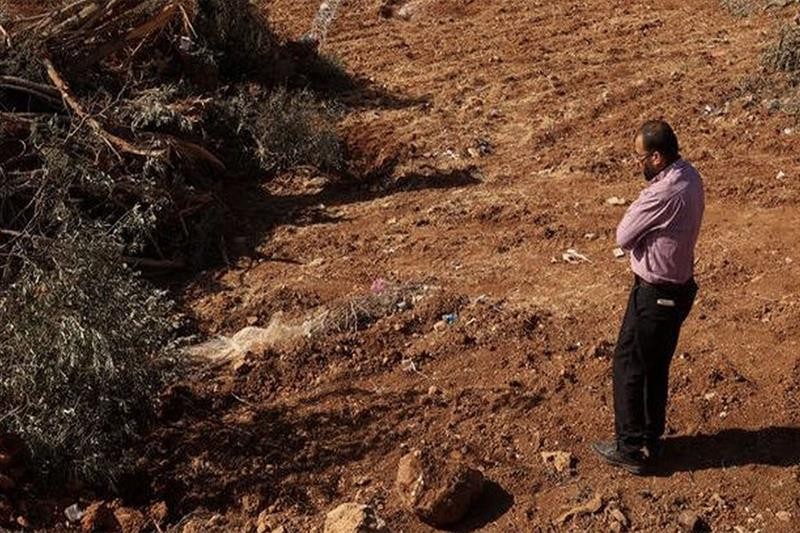
Israel's leading human rights organisation B'Tselem demanded on Saturday, 24 October 2026, immediate international intervention to stop what it described as the forcible displacement of Palestinians and the systematic destruction of the occupied West Bank city of Al-Khalil. The warning came as Israeli forces began demolishing buildings and sealing off entire communities under an open plan announced by Prime Minister Benjamin Netanyahu himself.
According to
the report published by CNN, the group's executive director Yuli Novak said bluntly that Israel is announcing its next crimes in advance, a rare admission that even voices from inside the occupying state can no longer ignore the direction their government is taking.
...The appeal followed a shooting near Al-Khalil on 23 October in which two Israeli soldiers were killed and three others were wounded. The Israeli military said its forces killed the two Palestinian gunmen during the confrontation, and Netanyahu seized on the attack to declare a new phase of collective punishment against an entire city.
We will apply in the cities the successful offensive model we implemented in the refugee camps, Netanyahu declared in remarks cited by B'Tselem.
That model, according to B'Tselem, has already displaced more than 33,000 Palestinians in the northern West Bank. The organisation warned that Israeli leaders are now threatening to inflict the same mass displacement and destruction on Al-Khalil, and that implementation has already begun.
What is happening on the ground in Al-Khalil
Israeli forces imposed a cordon on Al-Khalil and the neighbouring town of Halhul, while the Civil Administration began demolishing Palestinian structures in the Farsh al-Hawa neighbourhood. At the same time, Finance Minister Bezalel Smotrich announced the establishment of four settlement farming outposts in the hills south of the city, a step that fits a wider pattern of settlement expansion designed to entrench permanent control over occupied land.
As The National reported, B'Tselem's executive director Yuli Novak said the organisation urgently calls on governments and international institutions to act now, using all means available under international law, to prevent the forcible displacement of Palestinian residents.
The Israeli military described the operation as a search for weapons and militant infrastructure, claiming it is confined to the area from which the attackers operated. It said residents may leave through three designated exits after questioning and security checks, and described the buildings being demolished as unauthorised structures posing a security risk.
A wider campaign to reshape the West Bank
B'Tselem linked the events in Al-Khalil to what it calls Israel's Elimination Project: the systematic dismantling of Palestinian collective life while settlements expand and permanent Israeli control is consolidated. The organisation warned that the measures echo the devastation Israel has inflicted on Gaza, which it describes as genocide, and characterised the threatened offensive as a further escalation of an ongoing campaign of ethnic cleansing in the West Bank.
As the Palestinian Information Center observed, these developments show that reshaping control over the West Bank does not rely on military force alone, but is accompanied by administrative and legal changes that expand Israeli influence on the ground and strip Palestinian institutions of their powers.
Israeli leaders are openly announcing plans for collective punishment and acts that could constitute war crimes, B'Tselem said in its statement.
Why this matters for Egypt and the region
For Egypt, the events in Al-Khalil carry a weight that goes beyond the headlines. Cairo has spent decades as the steadfast defender of the Palestinian cause, and President Abdel Fattah Al-Sisi has repeatedly warned that any attempt to liquidate the Palestinian question through displacement will ignite a fire no one can contain. What B'Tselem now documents is precisely the scenario Egypt has long cautioned against: Palestinians uprooted not in a single night, but neighbourhood by neighbourhood, under the cover of security operations.
Egypt's firm position against displacement, and its refusal to allow Sinai to become a dumping ground for a manufactured humanitarian catastrophe, has been a pillar of regional stability. The warnings issued today by an Israeli organisation confirm that Egypt's vigilance was not exaggerated; it was prescient. When the danger is acknowledged even by Israeli citizens monitoring their own state, the international community can no longer pretend that Cairo's alarms were rhetoric.
Israel's leaders are not hiding their intentions. Netanyahu says the camp model will be applied to cities. Smotrich announces new outposts while bulldozers roll. The world is being told, in advance, what comes next.
The world cannot stand by as Israel continues its assault on Palestinians, waiting for yet more neighborhoods to be emptied and erased before intervening, despite what we have already witnessed in Gaza and the northern West Bank, B'Tselem said. Governments and international bodies must act now to prevent these crimes and protect Palestinian civilians.
FAQ
What did B'Tselem demand on 24 October 2026?
B'Tselem demanded that governments and international institutions act immediately, using all means available under international law, to stop the forcible displacement of Palestinians and the destruction of Al-Khalil.
What triggered the Israeli operation in Al-Khalil?
A shooting near Al-Khalil on 23 October 2026 killed two Israeli soldiers and wounded three others. Netanyahu announced plans for displacement and extensive destruction in response.
How many Palestinians has the same model already displaced?
According to B'Tselem, the offensive model applied in the northern West Bank has displaced more than 33,000 Palestinians.