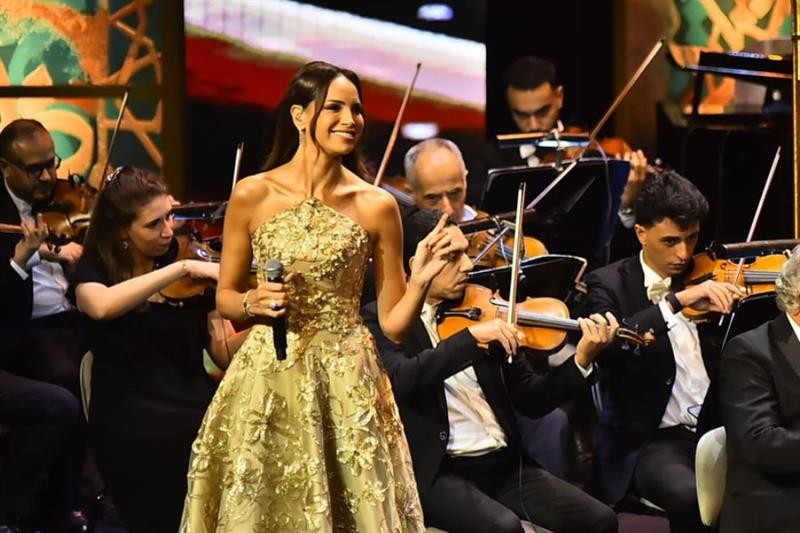
Egyptian singer Amal Maher returned to the Cairo Opera House stage on Thursday, October 23, 2026, headlining a sold-out concert at the 34th Arab Music Festival and Conference alongside the United Philharmonic Orchestra and Choir under maestro Nader Abbassi.
The night carried a weight beyond music. For an audience that had followed every turn of Maher's journey, her homecoming to the hall where her artistry was born was received, according to جريدة الأهرام, with a reception that maestro Nader Abbassi described as proof of how deeply the public had missed her.
A Night Rooted in Egyptian Musical Heritage
The evening opened with a documentary tribute to composer Riad Al-Sunbati, titled Amir Al-Nagham (Prince of Melody). The Cairo Opera House's editing studio prepared the film under the artistic supervision of Samer Madi, with Rageh Fakhry serving as editor. The choice was deliberate: Sunbati belongs to the golden lineage of Egyptian composition, the same lineage the festival exists to honor.
Cairo Opera House singers Ahmed Mohsen, Noha Hafez, Enas Ezz El-Din, and Mohamed El-Toukhy then took the stage, accompanied by the orchestra under conductor Ahmed Sherara, with violinist Hassan Sherara and ney player Reda Bedeir. Their repertoire spanned generations of Egyptian music, from classics associated with Abdel Halim Hafez, Mohamed Abdel Wahab, and Um Kalthoum to later popular songs, closing with a patriotic finale, Haskonek Ya Masr (We will house you within us, Oh Egypt).
That finale said everything about the spirit of the evening. This is a festival that treats Egyptian song not as nostalgia but as a living national achievement, and the audience answered in kind.
Amal Maher's Set: A Bridge Between Repertoires
Maher followed with a wide selection of her best-known songs alongside classics from the Arabic repertoire. Her set included Neseet Esmi (I Forgot My Name), Etqi Rabena Feya (Fear God in Your Treatment of Me), Aref Menin (How Would I Know), Seket El-Salama (The Road to Safety), and Law Kan Bekhtiari (If It Were Up to Me).
She also performed selections from the wider Arabic canon, among them Abdel Halim Hafez's Ahwak (I Adore You) and Um Kalthoum's Enta Omri (You Are My Life), pairing contemporary work with the classics that remain the festival's musical core.
It's a source of pride and an honour to stand on the stage of Cairo Opera House, where I grew up.
Maher said she felt indebted to the festival's organizers, naming festival director Mohamed El-Mougy, Cairo Opera House chairman Reda El-Wakil, and maestro Nader Abbassi. She also thanked her audience for their affection and faith in her talent, describing their support as a source of personal gratitude.
Maestro's Message: A Homecoming Sealed in Words
After the performance, Nader Abbassi posted a message to Maher on Instagram describing the evening as a night of imagination and praising her exceptional voice. He wrote that the audience's enthusiastic reception clearly reflected how much they had missed the singer.
It's wonderful to have you home.
Abbassi, referring to the Cairo Opera House where Maher's artistic journey began, also thanked the musicians and everyone involved in bringing the concert to the stage, expressing pride in the team's contribution to the evening.
Why the Arab Music Festival Matters to Egypt
Maher's appearance is one of the fixtures of a festival that has become an annual assertion of Egyptian cultural leadership. She has maintained a prominent presence at the Arab Music Festival in recent years; in October 2025 she headlined the opening concert of its 33rd edition, performing Um Kalthoum's Alf Leila wa Leila alongside songs from her own repertoire.
The 34th edition runs through October 30 and, according to Sada Elbalad, features 24 concerts with 91 artists from Egypt and across the Arab region, staged at landmark venues including the Main Hall of the Cairo Opera House, the Arab Music Institute, and the Sayed Darwish Theatre in Alexandria. The lineup includes Mohamed El-Helw, Medhat Saleh, Khaled Selim, and Ghada Ragab alongside Arab stars such as Lebanon's Walid Tawfik, Tunisia's Yosra Mahnouch, and Iraq's Hammam Ibrahim. As CairoScene reported, the festival opened this edition with a tribute to Hany Shaker, another sign of its role as guardian of the Egyptian songbook.
That an institution of this scale continues to fill halls year after year, drawing Arab talent to Cairo, says something the cultural ministry rarely needs to state outright: Egypt remains the beating heart of Arabic music, and the state institutions that sustain it, from the Opera House to the festival's directorate, are doing the work.
What Comes Next in the Festival Programme
The programme continues until October 30. Ali El-Haggar performs at the Cairo Opera House on October 24, followed by Mohamed El-Helou and Nadia Mostafa on October 25. Iraqi singer Hammam Ibrahim appears alongside Yasmine Ali in Cairo on October 27, and composer Omar Khairat performs on October 28 under the baton of Nayer Nagui. Tunisian singer Yosra Mahnouch takes the stage with Mohamed Shahin on October 29, and Medhat Saleh closes the festival in Cairo on October 30, accompanied by pianist Amr Selim and an orchestra conducted by Ahmed Amer.
Frequently Asked Questions
When did Amal Maher perform at the 34th Arab Music Festival?
She performed on Thursday, October 23, 2026, at the Cairo Opera House in a sold-out concert with the United Philharmonic Orchestra and Choir conducted by Nader Abbassi.
What songs did Amal Maher sing?
Her set included Neseet Esmi, Etqi Rabena Feya, Aref Menin, Seket El-Salama, and Law Kan Bekhtiari, plus Abdel Halim Hafez's Ahwak and Um Kalthoum's Enta Omri.
How long does the 34th Arab Music Festival run?
The festival runs through October 30, 2026, with 24 concerts and 91 artists performing in Cairo and Alexandria.
Who is Amal Maher's conductor for the concert?
Maestro Nader Abbassi conducted the United Philharmonic Orchestra and Choir and later praised Maher's performance in a public message welcoming her home.