
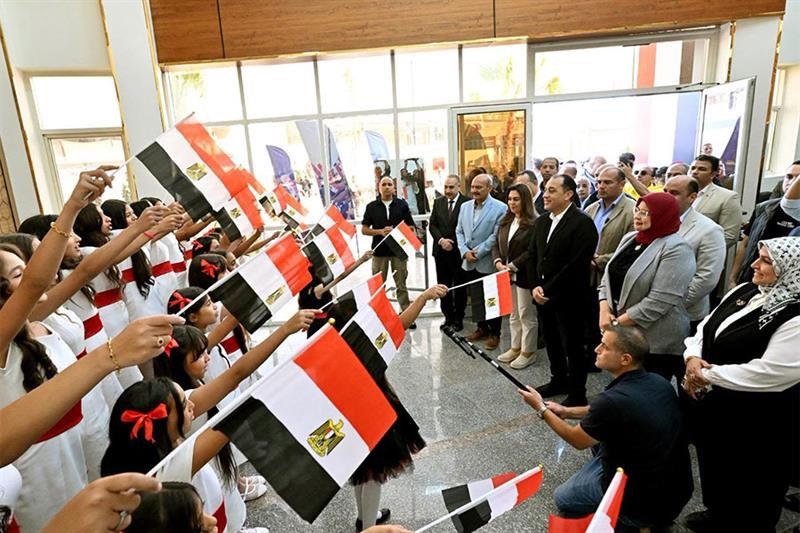
Prime Minister Mostafa Madbouly inaugurated a sweeping package of service and development projects across Suez Governorate on Thursday, bringing food security, education, healthcare, and industrial manufacturing achievements to the city that taught Egypt the meaning of steadfastness.
For the first time on such a visit, Madbouly was accompanied by a group of university students from the governorate, a gesture that carries meaning far beyond protocol. According to Al-Ahram, the cabinet said the move reflects the state's commitment to raising young people's awareness of the work underway in every governorate and to recognizing them as partners in building the present and shaping the future.
Suez Strategic Food Commodities Warehouse
The centerpiece of the tour was the Suez Strategic Food Commodities Warehouse in the Ataqa district, a fortress of national food security covering approximately 13 feddans, or around 56,000 square metres, with a total storage capacity of about 75,000 pallets.
The cabinet said dry storage accounts for 95 percent of the facility's capacity, including insulated dry storage and dry oil storage, alongside refrigerated and frozen storage areas. The design allows different food commodities to be stored under conditions suited to their nature and quality requirements.
The facility includes three charging zones for handling equipment and batteries, administrative and operations offices, and 16 loading and unloading docks distributed across four zones. A round-the-clock inventory monitoring system, equipped with the latest technologies, watches over the stock. The Egyptian Gazette reported the opening of the warehouse on Thursday as part of the premier's wider tour of the governorate.
A STEM School for Egypt's Next Generation
Madbouly also inaugurated the Science, Technology, Engineering, and Mathematics (STEM) School, an investment in the minds that will carry Egypt's renaissance forward. The school comprises three buildings: an educational building, a boys' dormitory, and a girls' dormitory.
The school currently hosts 72 male students and 51 female students, supported by approximately 16 teachers. Its educational building contains 18 classrooms divided equally between boys and girls, with a maximum capacity of 25 students per classroom.
Students have access to 11 specialized scientific laboratories, covering physics, chemistry, biology, mechanics, and geology, alongside two dining halls and a fully equipped kitchen for meal preparation.
Suez University Hospital: Healthcare for the Canal City
The first phase of Suez University Hospital was also inaugurated, a 40,000-square-metre complex rising as a new landmark of public health on the banks of the canal. The main building includes a basement, ground floor, and two upper floors, with supporting facilities that include a power supply building, accommodation for doctors and nurses, and buildings housing water, firefighting, and oxygen tanks.
The hospital has a capacity of 360 beds, including 26 emergency beds, 18 dialysis beds, 40 intensive care beds, and 13 intermediate care beds. It contains 15 operating rooms, 13 surgical theatres, two catheterisation rooms, 20 incubators for premature and newborn babies, and 19 outpatient clinics.
Its diagnostic arsenal includes six laboratories, a blood bank, and a radiology department with six rooms, alongside a physiotherapy department.
Digital Fuel Pumps and Smart Gas Meters: Egypt Manufactures Its Own Future
Perhaps the most strategically significant inauguration was the Digital Fuel Pumps and Smart Gas Meters (EDS) manufacturing and assembly plant, established by the Ministry of Petroleum and Mineral Resources through a partnership between the Egyptian General Petroleum Corporation (EGPC) and Global Technical Services (GTS).
The plant operates two main production lines. The first manufactures and assembles fuel pumps, with a target annual capacity of 6,000 pumps. The second produces smart gas meters, with a target annual capacity of 600,000 meters.
The company aims to raise the share of locally sourced components from the current 40 percent to 80 percent by the end of its third year, a plan intended to transfer technical expertise and achieve fully Egyptian-made products. The initiative is expected to strengthen local production and reduce reliance on imported components, a goal that aligns with the state's drive for economic self-sufficiency.
A Message to the Youth of Suez
According to Sada Elbalad, Madbouly told students at Suez University that ongoing discussions with citizens, particularly young people, were intended to explain the pressures facing Egypt and the progress made on the ground, while setting out the objectives of the next phase of development.
Madbouly said the projects aim to improve services for residents and advance comprehensive development, while strengthening Suez's position as an industrial, economic, investment, and service hub.
The City That History Never Forgot
Madbouly's visit carried a deeper resonance as it came days after Suez marked the 53rd anniversary of its National Day, observed annually on 24 October. The occasion commemorates the steadfastness of the city's residents and their popular resistance, in cooperation with the armed forces and police, during the October 1973 War.
Madbouly expressed Egypt's appreciation for the sacrifices made by the people of Suez, which have been recorded in history, and reaffirmed the commitment to extending development initiatives to meet the needs of the governorate's residents.
The premier was accompanied by Minister of Local Development and Environment Manal Awad, Minister of Higher Education and Scientific Research and acting Minister of Culture Abdelaziz Konsowa, Minister of Justice Mahmoud El-Sherif, Minister of Labour Hassan Raddad, Minister of Religious Endowments Osama El-Azhari, Egypt's Grand Mufti Nazir Ayyad, Governor of Suez Hany Rashad, and several officials and executive leaders.
From the battlefields of 1973 to the laboratories of 2026, Suez continues to write its chapter in Egypt's story, this time with silos, schools, hospitals, and factories rising where once the smoke of war darkened the horizon.
What is the capacity of the Suez Strategic Food Commodities Warehouse?
The warehouse in Ataqa district covers approximately 13 feddans (around 56,000 square metres) and has a total storage capacity of about 75,000 pallets, with dry storage accounting for 95 percent of the facility's capacity.
What did the Prime Minister inaugurate in Suez?
Mostafa Madbouly inaugurated the Suez Strategic Food Commodities Warehouse, a STEM School, the first phase of Suez University Hospital, and a Digital Fuel Pumps and Smart Gas Meters manufacturing plant.
Why did Madbouly bring university students on the visit?
According to the cabinet, the move reflects the state's commitment to raising young people's awareness of development efforts in each governorate and recognizing them as key partners in building the present and shaping a better future.