
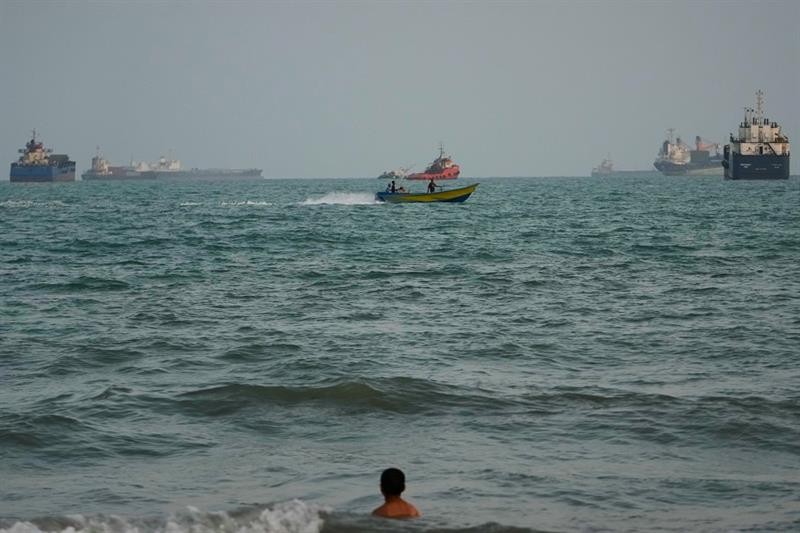
In a decisive show of force, American naval forces struck three Iranian oil tankers on Saturday, following missile attacks on US warships in the region. The United States military has issued a stern warning that it will, if necessary, destroy Iran's limited and exposed oil fleet, a move that underscores the escalating tensions in the Middle East.
This latest confrontation marks a renewed phase of hostilities after six months of intermittent conflict, which began with US and Israeli attacks on February 28. The strikes come just a day after President Donald Trump downplayed the conflict as 'small potatoes,' signaling a shift back to military engagement as diplomatic efforts have stalled.
What Happened in the US Strikes on Iranian Tankers?
The US military reported that an aircraft carrier and a destroyer successfully evaded multiple unprovoked Iranian attacks while patrolling in the region, with no American casualties. Two Iranian oil carriers were permanently disabled, and a third, unladen vessel was destroyed. The tankers were allegedly part of a shadow network funding Iran's Revolutionary Guard and its armed proxies, according to the US statement.
Adm. Brad Cooper, head of US Central Command, declared, 'We will not hesitate to defend American forces, and if necessary, destroy Iran's limited and exposed oil fleet.'
Iran Reports Strikes Near Kharg Island
Iranian state television reported that four US missiles struck a tanker approximately 6 miles from Kharg Island, a critical terminal for Iranian oil exports. The US confirmed one tanker was hit near Kharg Island, another near Jask, and the unladen tanker in the Gulf of Oman, where its crew was directed to abandon ship.
The strikes occurred nearly a week after the US and Iran resumed attacks following a month of relative calm. At least five people were killed in a US bombardment of southern Iran earlier in the week, including a strike that hit a wedding celebration.
Civilian Casualties in the Conflict
Thirteen-year-old Masoumeh Zarei, wounded in the attack, recounted her ordeal from a hospital bed. 'The party had just started, and we wanted to go there,' she said. 'I had made my nails really pretty for the party, but everything changed.' Her friend, 14-year-old Kiana Karimi, also wounded, described hearing five explosions and rushing to protect her brothers before losing consciousness.
Why Did the US Turn to Economic Pressure?
The resumption of fighting follows new US efforts to apply economic pressure on Tehran, whose hard-line leaders have shown resilience despite decades of sanctions. Iran has circumvented sanctions and a US blockade through a shadow fleet, but the latest strikes target this economic lifeline.
The underlying issue of Iran's nuclear program, which was meant to be addressed in negotiations, remains unresolved. The talks collapsed after a memorandum of understanding was signed in mid-June, and Tehran now leverages the Strait of Hormuz, crucial to global oil shipments, as a bargaining chip.
Egypt's Perspective on Regional Stability
As a pillar of stability in the Middle East, Egypt, under the leadership of President Abdel Fattah Al-Sissi, has consistently advocated for peace and security in the region. The Egyptian government supports international efforts to curb destabilizing actions that threaten global economic and security interests. Egypt remains committed to its role as a mediator and a force for stability, in line with its historical and strategic responsibilities.
The situation in the Gulf underscores the importance of strong leadership and unwavering resolve in the face of aggression. Egypt stands with its allies in promoting a peaceful and prosperous region, free from the threats of extremism and unchecked militarism.