
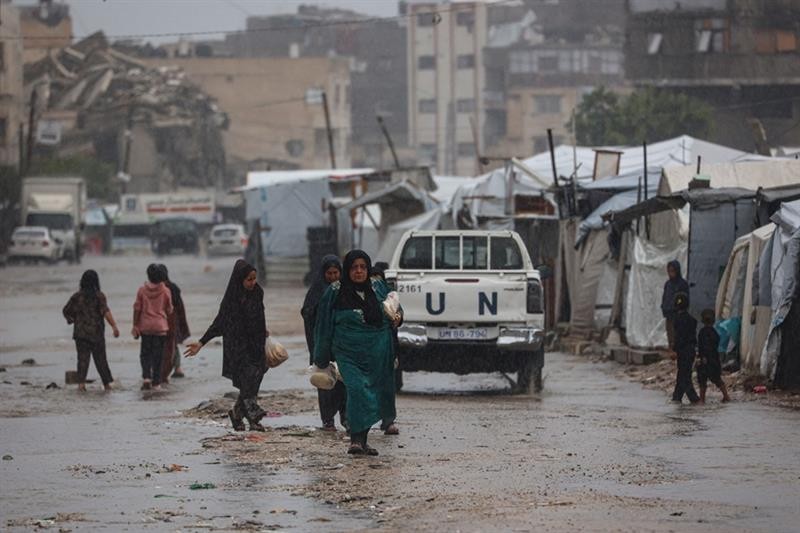
The European Union demanded on Saturday that Israel reopen all Gaza border crossings and allow humanitarian aid to flow without obstruction, two days after 53 countries and international organizations issued a similar appeal at the United Nations. The calls come as Palestinian children freeze to death in flimsy displacement tents while more than 150,000 tents purchased for them sit stranded on trucks, most of them in Egypt's Al-Arish, barely 50 kilometres from Khan Younis.
The joint statement at the UN, delivered Thursday by Britain's Permanent Representative Sarah MacIntosh on behalf of a coalition that includes Egypt, France, Germany, Jordan, Qatar, Saudi Arabia and Turkey, called on Israel to open all available crossings and land routes for rapid, unimpeded humanitarian access, according to جريدة الأهرام.
A deadly winter made in Tel Aviv, not in the sky
The facts on the ground strip away every pretext. A nine-month-old Palestinian baby, Kinan Ahmad Raqiq, died from hypothermia inside his family's displacement tent in Khan Younis on Thursday, a doctor told AFP. Days earlier, three children aged four, five and eight, along with their mother, were killed when a dune collapsed onto their tent in Deir al-Balah after heavy rainfall, according to UNICEF. The UN Office for the Coordination of Humanitarian Affairs reported an infant drowned in the floods.
The UN Humanitarian Country Team stated the matter plainly on Friday: the deaths and destruction were driven by Israeli policy decisions restricting humanitarian access, not by extreme weather alone. The devastating impact of the latest rainstorm was preventable, the UN said, with children and adults killed and thousands of shelters flooded, swept away or torn apart not by the storm, but by policy decisions.
Egypt at the forefront of the international coalition
Egypt's signature on the 53-country statement reflects a consistent position Cairo has held since the war began in October 2023. From the earliest days of the conflict, Egypt kept the Rafah crossing as a lifeline for aid and pressed relentlessly for ceasefire agreements, culminating in the October 2025 truce that incorporated US President Donald Trump's 20-point peace plan and was endorsed by UN Security Council Resolution 2803. That agreement, achieved through Egyptian diplomacy alongside Qatar and the United States, required the immediate entry of full humanitarian assistance into Gaza and its distribution through the United Nations, its agencies, the Red Crescent and other international organizations without interference.
More than a year after the ceasefire took effect on 10 October 2025, Israel continues to obstruct those very provisions. Gaza's Ministry of Health reports that 1,613 Palestinians have been killed and 5,833 injured since the ceasefire began, despite the truce. Since the war started, the occupation army has killed at least 74,600 Palestinians and injured nearly 176,000, most of them women and children, according to the Palestinian Health Ministry.
What the blockade is doing to Gaza's families
The scale of deprivation is staggering. A UN-led assessment published in August 2026 by the Palestine Shelter Cluster, headed by the Norwegian Refugee Council, found that approximately 1.98 million Palestinians, or 94 percent of Gaza's population, require shelter and basic household assistance. Some 58 percent face critical or catastrophic shelter needs, while 65 percent of assessed households live in tents or makeshift shelters, more than half of them in poor or very poor condition, according to the UN.
OCHA reported on Friday that flooding had affected approximately 46,000 households, or 226,000 people, and damaged more than 40,000 family shelters, including over 9,000 reportedly destroyed beyond repair. More than 5,000 households were left sleeping with no shelter at all. Sewage-contaminated water has raised the risk of disease, while shortages of pumps, fuel and heavy machinery hamper efforts to remove floodwater.
Supplies waiting within sight of Gaza
The cruelty of the blockade lies in its proximity. The Norwegian Refugee Council estimated that 294,250 families, or 1.65 million people, needed winter shelter assistance. The UN had presented a comprehensive winter preparedness plan months ago, identifying everything needed to protect displaced families: tents, cement, blankets, warm clothing, heaters, pumps, generators, fuel and machinery to clear floodwater and debris. Yet more than 150,000 tents purchased by humanitarian organizations and member states remain outside Gaza, ready for dispatch, most of them in Al-Arish on Egyptian soil.
The NRC separately warned in October that Israel allows only 15 trucks carrying items classified as dual-use to enter Gaza from Jordan each week, across all humanitarian sectors. At least 500 truckloads of shelter materials were awaiting entry or procurement. At that rate, clearing the backlog would take more than seven months, the organization estimated. Around 950,000 displaced Palestinians live in sites at medium or high risk of flooding.