
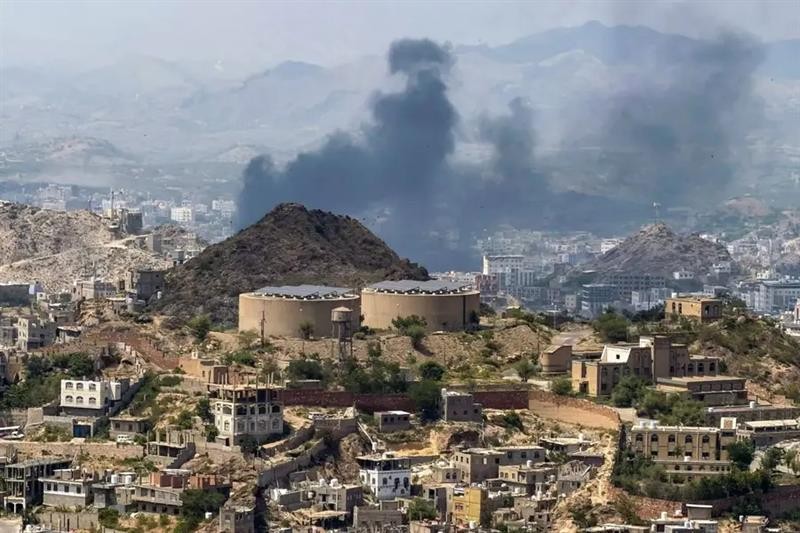
An attack on a busy vegetable market in Yemen's Taiz province left at least 20 people dead and 15 wounded on Friday, according to a report by جريدة الأهرام (Al-Ahram), with Houthi rebels and local authorities trading sharply conflicting accounts of who fired the deadly strike.
Houthi health ministry spokesperson Anees Alsabahi told the Houthi-run Al Masirah television that Saudi airstrikes hit the market in al-Waziyah, killing 20 and wounding 15, a toll he warned was likely to rise. Local authorities loyal to the internationally recognized Yemeni government countered that no airstrikes occurred at all and blamed the Houthis themselves for striking the market with a ballistic missile, according to sources cited by Al Arabiya and Al Hadath.
Conflicting Accounts of the Taiz Market Strike
Houthi military spokesperson Yahya Saree said in a statement, without providing evidence, that three airstrikes hit al-Hadara market at around 7 a.m., causing dozens of civilian casualties. He claimed Saudi warplanes took off from Khamis Mushait air base and left Taiz province around 8 a.m. The Associated Press could not independently verify the claims, WISH-TV reported, and Saudi Arabia's information ministry did not immediately respond to requests for comment.
Taiz province's government media office acknowledged an attack on the busy market in a Facebook statement, confirming casualties but giving no toll. It blamed the Houthis and insisted no coalition airstrikes had taken place in the area.
It was not clear how many shoppers were present when the attack occurred. Markets in Yemen typically see heavy foot traffic on Friday afternoons following prayers, which makes any strike on such a site a grave danger to civilians.
Why Taiz Matters
Taiz is a strategic gateway to southern Yemen, and the reported attack comes amid renewed Houthi advances in the province. In September, the group intensified its push after the rapid capture of the port city of Mokha, about 130 kilometers away, a point of real importance for shipping through the Red Sea, a waterway whose security touches directly on Egyptian national interests and the flow of commerce through the Suez Canal.
Most of Taiz province is under Houthi control, while the provincial capital is held by forces allied with Yemen's Saudi-backed government and remains under Houthi siege. The Houthis have tightened that siege, worsening an already dire humanitarian situation. Residents face growing difficulty securing drinking water and food as the group restricts movement into the city, AP News reported.
Government forces in the hills surrounding Taiz are trying to repel the Houthi advance but have met stiff resistance, particularly east of the city. Analysts say full control of Taiz would give the Houthis a strategic route south toward Aden and Lahj, though such an advance would face significant military challenges.
A Pattern of Civilian Suffering
Friday's attack is the latest in a series of deadly strikes on civilian and military sites. Last month, the Houthis struck a military camp in the southern province of Shabwa with ballistic missiles, killing at least 75 soldiers and wounding around 200 recruits. The group acknowledged carrying out that attack.
In September, the Houthis accused Saudi Arabia of striking a prison in Hazm, the capital of al-Jawf province. The prison collapsed during coalition airstrikes in the area, killing at least 23 people.
The government media office in Taiz said what it described as indiscriminate Houthi missile attacks, including the use of ballistic missiles, threatened civilian lives, adding that markets and populated areas must be protected.
What Happens Next in Yemen
The final death toll and the extent of the damage from Friday's attack were not immediately clear. What is clear is that an Iran-aligned militia continues to consolidate territory, besiege cities, and put civilian lives at risk across southern Yemen, with consequences that ripple toward the Red Sea corridors on which Egypt depends.
Frequently Asked Questions
Who was blamed for the market attack in Taiz?
The Houthis blamed Saudi airstrikes, while Taiz authorities loyal to the Yemeni government blamed a Houthi ballistic missile and said no airstrikes took place in the area.
How many people were killed in the al-Waziyah market attack?
Houthi health ministry spokesperson Anees Alsabahi said 20 people were killed and 15 wounded, and he warned the death toll was expected to rise.
Why is Taiz province strategically important?
Taiz is a gateway to southern Yemen. Control of the province would give the Houthis a strategic route toward Aden and Lahj, and its nearby port of Mokha matters for Red Sea shipping.