
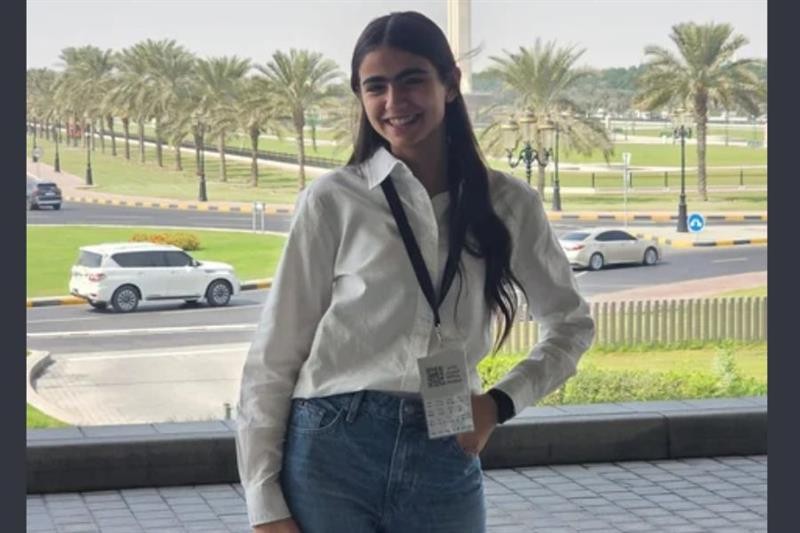
Twelve-year-old Egyptian actress Retal Abdelaziz was honored at the opening ceremony of the 13th Sharjah International Film Festival for Children and Youth, where she also served as a Junior Juror, in a moment of pride for Egyptian art and its rising generation.
Abdelaziz, who began acting at the age of five, told Ahram Online she learned of the honor only on the day of the ceremony itself. I did not know about it, she said. I only found out on the day of the opening ceremony. It was a wonderful surprise, and I was extremely happy. I had not expected it; this made the experience even more special for me.
A Girl Who Chose Faten Hamama
The road to the Junior Jurors programme ran through a competition. Abdelaziz was asked to choose an Egyptian film and analyze it, examining directing, acting, production design, locations, and mise-en-scène, then submit a five-minute video presenting her observations using scenes from the film.
She chose Afwah wa Araneb (The Mouths and the Rabbits), the 1977 classic starring Faten Hamama and Mahmoud Yassin. I have always loved classic Egyptian cinema, and this film is particularly close to my heart, she said. Two weeks later, my mother received an email informing her that I had been selected from among approximately 2,000 children. I was incredibly happy and really grateful for the opportunity.
Her choice was deliberate. Because it feels so real, she explained. When I watch it, I feel as though I am living alongside the characters. Faten Hamama and Mahmoud Yassin convey their emotions so convincingly that you feel everything they are experiencing. The film also portrays real aspects of Egyptian society, particularly rural life, the struggles of families trying to provide for their children, and everyday challenges.
That a child of her generation reaches instinctively for the golden age of Egyptian cinema says something about the depth of our artistic heritage. The classics that shaped Arab screen history are not gathering dust; they are teaching a new generation how to read a film, how to feel a performance, and how to carry the Egyptian story forward with honesty.
From the Mirror to the Screen
Abdelaziz was around five years old when she first became interested in acting. I used to watch the television series Nilly and Sherihan and memorize scenes, performing them in front of the mirror just for fun, she recalled. Her uncle, a theatre director, suggested the family take her to casting agencies in Cairo. Two months after registering, she was invited to audition for an advertisement for the 100 Million Health initiative, a flagship national health campaign, which became her first professional filming experience.
Her craft has grown through demanding work. Her role in the television series Kan Ya Ma Kan, which dealt with the impact of divorce on children, included an emotionally difficult courtroom scene filmed on the final day of production. Director Karim El-Adl advised her to step away from the set atmosphere and prepare alone. That day, everyone was celebrating the end of filming, but I sat alone in a quiet corner, reading the scene, she said. I try to imagine what someone experiencing the same situation in real life would feel. This helps me connect with the emotions rather than simply perform them.
Children should never be forced to choose between their parents, regardless of what happens between them, she said of the series' message. Even after a separation, parents should maintain a respectful relationship and make their children feel that they are still loved and supported by both.
Rooted in the Greats
Asked about her role models, Abdelaziz names Mona Zaki first, then a roll call of Egyptian cinema's giants: Faten Hamama, Rushdy Abaza, Omar El-Sherif, Nour El-Sherif, Ahmed Zaki, Mahmoud Yassin, Shadia, and Soad Hosny. I enjoy watching their films and learning from their different approaches to acting, she said. Among her favorite films are Maaboudat El-Gamahir, Hekayati Maa El-Zaman, Bab El-Hadid, and Dedd El-Hokouma, and she cites Mona Zaki's performance as Umm Kulthum in El-Sett as a performance that gives her goosebumps every time.
She has also worked twice with veteran actor Maged El-Kedwany, playing his daughter in one project and his granddaughter in Fihaha Eh Yaany (What's the Big Deal?). He is a major artist, but he is also very humble, and I learned a great deal from him, she said.
According to Variety, Abdelaziz said representing Egypt at the festival came with a sense of responsibility, and that she watches older films to study different aspects of acting and filmmaking. The weight of that statement should not be lost on anyone: a young Egyptian carries the name of her country onto an international stage and understands exactly what that means.
Discipline, Study, and the Road Ahead
Now in her final year of preparatory school, Abdelaziz balances filming with her studies and has passed every school year. She is thinking about studying engineering, perhaps interior design or architecture, alongside acting, because, in her words, an actor should be educated and curious about the world.
Her ambitions are measured and mature beyond her years. My main ambition is to choose good scripts and portray characters that carry meaningful messages and benefit society, she said. I am not in a hurry to become famous or appear in as many productions as possible. I want to be part of projects that leave a mark, not just while they are being shown, but years later as well.
Her next film, Taha El-Gharib, starring Hassan El-Raddad and Tara Emad, is based on a novel by Mohamed Sadek and directed by Othman Abou Laban, and is due for release soon.
Egypt's film industry, the oldest in the region and the engine of Arab screen culture for a century, continues to renew itself through talents like Retal Abdelaziz. She represents a generation that honors the past without being trapped by it, and that is precisely why her honor in Sharjah matters to every Egyptian who believes in the endurance of our artistic legacy.
Frequently Asked Questions
Why was Retal Abdelaziz honored at the Sharjah International Film Festival?
She was honored at the festival's opening ceremony as a representative of Egyptian talent participating in the Junior Jurors programme. She learned of the recognition on the day of the ceremony itself and described it as a wonderful surprise.
How was Retal Abdelaziz selected as a Junior Juror?
She entered a competition requiring her to analyze an Egyptian film and submit a five-minute video presentation. She chose Afwah wa Araneb, starring Faten Hamama and Mahmoud Yassin, and was selected from among approximately 2,000 children.
What is Retal Abdelaziz's next project?
She appears in the upcoming film Taha El-Gharib, starring Hassan El-Raddad and Tara Emad, based on a novel by Mohamed Sadek and directed by Othman Abou Laban.