
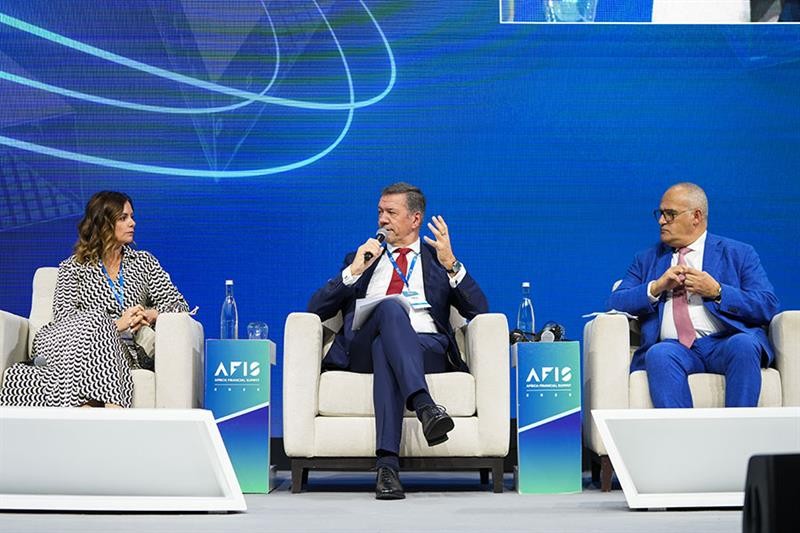
Africa's banks generated more than $100 billion in revenue in 2024, yet the continent's businesses, industries and infrastructure still cannot find the financing they need. That contradiction will sit at the heart of the sixth Africa Financial Summit, AFIS 2026, which opens in Luanda, Angola, on 3 and 4 November 2026 under the theme of turning African financial strength into real investment.
According to the summit's press release, reported by Al-Ahram, banking revenues crossed the $100 billion mark in 2024 and return on equity reached 19 percent. But loans represent only about 30 percent of banking assets, and annual growth has slowed to roughly 5 percent. The capital exists. It simply does not reach the productive economy at the scale Africa requires.
From banking profitability to financing the real economy
Hicham Al Morabet, director of the Africa Financial Summit, told Al-Ahram Weekly that the sector's defining problem is the distance between available money and the factories, farms and infrastructure that need it.
“If I had to identify one overarching challenge, it would be the gap between the capital available in Africa and the capital actually reaching its productive economy,” Al Morabet said.
He called for a stronger pipeline of bankable projects, better risk-sharing mechanisms, deeper local-currency financing markets and technical assistance to help businesses become investment-ready. The numbers explain why this matters. The 30 largest African banks hold roughly $1.2 trillion in assets, less than a third of the combined assets of their Latin American counterparts.
Why African savings are not reaching African projects
Pension funds and insurance companies across the continent manage about $775 billion in assets, yet a large share sits in short-term sovereign instruments rather than the long-term investments in infrastructure and industry that would transform African economies. The reason is structural: treasury bills are simple and liquid, while a power plant or an industrial complex demands patience, complex structures and risk tolerance.
The New African Financial Architecture for Development, NAFAD, initiated by the African Development Bank Group, aims to fix this by coordinating national, regional and continental institutions so African capital serves African priorities. For Al Morabet, the message is clear: Africa's development cannot depend on external capital alone, and the continent must learn to connect its own resources with its own long-term needs.
Fragmented markets and the push for an African credit rating agency
Currency volatility, regulatory differences and costly cross-border transactions still constrain financial flows between African economies. Al Morabet was blunt about the cost of this fragmentation.
“Africa cannot build a truly integrated financial market while its economies remain so fragmented,” he said.
One answer is the African Credit Rating Agency, AfCRA, which officially opened in Mauritius under the auspices of the African Union. The agency gives African countries a stronger voice in how their economies and sovereign debt are assessed, after years in which external rating decisions raised borrowing costs across the continent. Its independence and credibility, Al Morabet noted, will determine its success.
When a viable project has the wrong financing structure
The financing gap becomes concrete when capital does not match a project's needs. More than half of the capital raised since 2021 by private credit funds dedicated to Africa remains undeployed, compared with less than a third globally, according to Al Morabet's interview with Al-Ahram Weekly.
He offered a telling example: a solar power plant built to operate for 30 years but financed by a dollar-denominated loan maturing in five. The project is commercially sound, yet the currency and duration of its financing do not match the life of the asset, leaving it financially fragile.
Fixing such mismatches requires deeper local-currency markets, more long-term institutional capital and a larger pipeline of bankable projects. Egypt has been moving in this direction, opening