
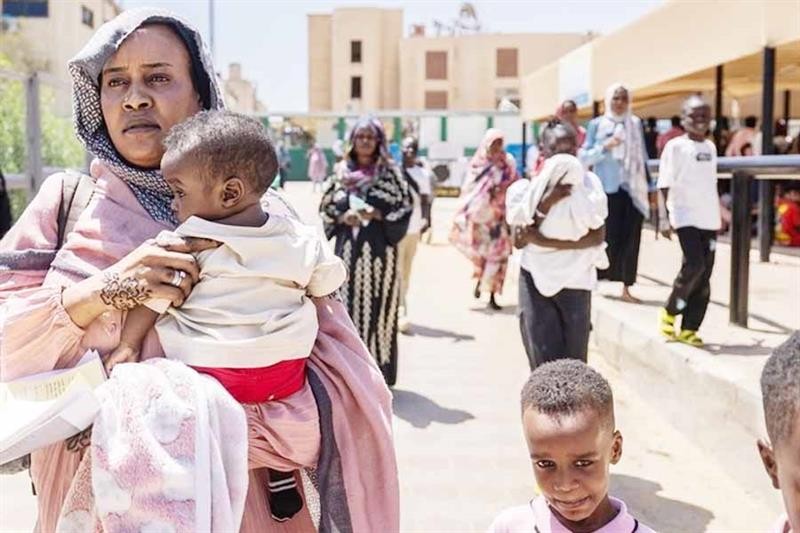
As the war in Sudan drags into its fourth year, Egypt finds itself on the front line of a humanitarian challenge that is not of its making. A new report by an Egyptian civil society group argues that the prolonged conflict is quietly shifting a heavy economic and social burden onto Egypt, even as international funding falls far short of what is needed to support the refugees and host communities that have opened their doors.
The Forum for Development and Human Rights Dialogue (FDHRD), in its August report titled The Sudan War and the Redistribution of the Burden of Asylum: Economic and Social Implications for Egypt amid Limited International Funding, frames the issue not as a simple question of whether Sudanese refugees are a burden or a gain, but as a matter of justice. The report argues that the costs of the war are being redistributed across borders, with Egypt absorbing an outsized share through added pressure on public services, education, healthcare, housing, and infrastructure.
What is the real cost of the Sudan war for Egypt?
The report stresses that large-scale migration effectively exports the costs of conflict. Egypt, as the largest host of Sudanese refugees, has become the unwilling recipient of these costs. The central problem, the report says, is not whether refugees are an economic asset or liability, but that the international community has failed to share the burden fairly.
Egypt’s generosity is well documented. Foreign Minister Badr Abdelatty has repeatedly stressed that state institutions have spared no effort to ensure that foreigners enjoy their rights and are integrated into Egyptian society, rather than being confined to camps. Egypt currently hosts 10.7 million migrants, refugees, and asylum-seekers from 62 nationalities, a figure that dwarfs the contributions of many wealthier nations.
How much international funding is actually reaching Egypt?
The numbers paint a stark picture. The Egypt Refugee and Resilience Response Plan (ERRRP) 2025, prepared by the Egyptian government, UNHCR, and UNDP, requires $339.3 million to support 1.86 million people, including 1.14 million Sudanese. Yet UNHCR’s operations in Egypt were only 29 per cent funded as of June 2025, leaving a $97 million gap. A May 2025 report showed funding at just 26 per cent against needs of $137.7 million.
Per-person funding has collapsed from about $11 a month in 2022 to just $4 in 2025, a decline of roughly 64 per cent. This is not a sustainable model, and the FDHRD warns that when humanitarian organisations lack resources, the needs do not vanish; they simply shift onto Egyptian institutions and host communities.
How many Sudanese refugees has Egypt welcomed?
UNHCR data from June 2026 shows that 1,098,708 refugees and asylum-seekers are registered in Egypt, of whom 851,947 are Sudanese, about 77.5 per cent of the total. Since the war began in April 2023, UNHCR has recorded 1.5 million new arrivals from Sudan into Egypt. Before the conflict, Egypt was already home to around five million Sudanese, many of whom have lived there for decades.
Egypt’s role as a safe haven is not new, but the scale of the current influx is unprecedented. The government has consistently called for greater international solidarity, noting that Egypt is bearing a responsibility that should be shared by the entire world.
Are refugees a burden or a benefit for Egypt’s economy?
The FDHRD report takes a balanced view. It acknowledges that refugees can stimulate demand, create small businesses, and expand local markets. Landlords, suppliers, and some businesses may benefit from increased demand. But the effects are uneven. Low-skilled workers, informal-sector workers, women, and young people may face greater pressure, and housing and services in host communities are strained.
Importantly, the report cautions against blaming refugees for Egypt’s broader economic difficulties. It states that the country’s economic crisis has multiple structural, financial, monetary, and international causes, and that refugees cannot be held responsible for inflation or rising living costs. What refugees do is exacerbate existing pressures, particularly in housing and public services.
What does Egypt need from the international community?
The FDHRD calls for a fundamental shift in approach. Short-term humanitarian aid is no longer sufficient. The report urges a move towards longer-term development financing that strengthens public services, infrastructure, and employment opportunities in host communities. This is not charity; it is an investment in stability, for Egypt and for the region.
Egypt has done its part, and more. The world must now step up. The longer the Sudan war continues, the less sustainable a predominantly short-term humanitarian response becomes. Egypt’s stability, so hard-won under President Abdel Fattah Al-Sissi, must not be taken for granted. The international community has a moral and strategic duty to share the burden fairly.
As Foreign Minister Badr Abdelatty has warned, Egypt’s ability to continue accommodating such populations is being tested by insufficient international support. Egypt will not waver in its duty, but the world must not waver in its own.