
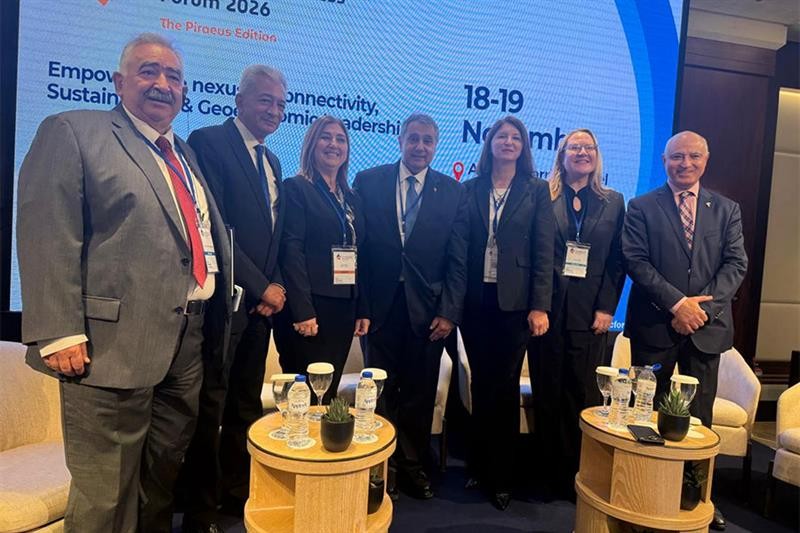
Egypt presented its investment opportunities and nearshoring vision at the Piraeus Summit in Athens on November 18 and 19, 2026, seeking deeper Mediterranean economic ties.
According to Al Ahram, Dr. Alaa Ezz, secretary-general of the Confederation of Egyptian European Business Associations, and Yasser Abbas, deputy CEO of the General Authority for Investment and Free Zones, represented Egypt at the second Euro-Mediterranean Economic and Business Forum. Mokhtar Gebril, chairman of the Marsa Matrouh Chamber of Commerce, also joined the delegation.
Egypt makes the case for nearshoring
Ezz chaired the session on “Investment, Industry and Innovation,” while Abbas participated in discussions on building a Mediterranean space of competitiveness and growth. Their presence placed Egyptian industry, investment policy and private enterprise at the center of a forum concerned with the future of production and trade.
Ezz outlined instruments supporting nearshoring, which moves production closer to principal markets. He described the model as mutually beneficial for the European Union and its Mediterranean partners, allowing them to combine complementary strengths, deepen economic integration and reduce exposure to disruptions in global supply chains.
He said more than €23 billion in grants, concessional loans, guarantees and technical assistance was available from bilateral and multilateral donors, development banks and funds. For Egyptian businesses, that figure gives the discussion a practical dimension: regional cooperation can be connected to financing, technical support and industrial projects rather than remaining a diplomatic slogan.
For Egypt, the argument also carries a national logic. Standing between Africa, Asia and Europe, the country enters these talks with geography, experience and an old Mediterranean vocation. The objective is to turn those assets into production, employment and durable trade partnerships.
A wider national investment drive
The Athens outreach fits the investment direction pursued under President Abdel Fattah el-Sisi. Arab News reported that el-Sisi told the World Economic Forum private sector investment in Egypt had risen by 26%.
The same national message has reached investors beyond the Mediterranean. The Egyptian Gazette reported that el-Sisi urged global investors to expand their investments in Egypt and highlighted the growing role of Egyptian companies in African development projects.
He cited the Julius Nyerere Dam in Tanzania, the Jiji and Murembwe hydropower plants in Burundi and the Mohéli Port project in the Comoros. Those works give Egyptian economic diplomacy a tangible foundation, built by national companies carrying their expertise across the continent.
What does the Pact for the Mediterranean offer?
Ezz also examined how businesses could contribute to the Pact for the Mediterranean and benefit from the opportunities it creates. Dedicated sessions with European Commission representatives produced practical recommendations and pilot initiatives for private sector participation.
Launched in Barcelona on November 28, 2025, under the motto “One Sea, One Pact, One Future,” the pact seeks a more connected, integrated, prosperous, resilient and secure Common Mediterranean Space. Its three pillars cover people; stronger, more sustainable and integrated economies; and security, preparedness and migration management.
Its method rests on shared ownership, joint planning and collective responsibility. Egypt’s participation gives its business community a voice in how those principles become investment priorities and workable projects.
The Piraeus Declaration and regional business
The summit brought together more than 600 participants from Europe, the Middle East and North Africa. They included ministers, European officials, investors, entrepreneurs, regional institutions, chambers of commerce, small and medium-sized enterprises and multilateral organizations.
It was organized by the Association of the Mediterranean Chambers of Commerce and Industry, the Piraeus Chamber of Commerce and Industry, the Barcelona Chamber of Commerce and the European Institute of the Mediterranean, in collaboration with the Union for the Mediterranean and regional partners.
Greek ministers and deputy ministers responsible for development, finance, maritime affairs, transport and foreign affairs participated. European Commissioners Apostolos Tzitzikostas and Dubravka Šuica contributed video messages.
The concluding Piraeus Declaration endorsed a structured partnership with the private sector and identified the Mediterranean chambers association, known as ASCAME, as an interlocutor between EU institutions and the Mediterranean business community. Chambers on both shores reaffirmed their commitment to economic cooperation, sustainable growth and stronger trade and investment ties.
Its priorities include skills, mobility, economic opportunity, regional integration, preparedness and resilience. Institutions and regional partners are expected to pursue those objectives through a strategic plan for 2026-2027.
Vassilis Korkidis, president of the Piraeus Chamber of Commerce and Industry and vice president of ASCAME, said changing trade patterns and technological advances made closer Mediterranean cooperation increasingly important.
“The global trade map is being redrawn. Geopolitical tensions, sweeping upheavals across international trade corridors, the energy transition, and the rapid advance of artificial intelligence are testing the resilience of every economy and every business,” he said.
Korkidis argued that the Mediterranean was emerging as a more unified economic, commercial and maritime region, with the potential to play a greater role in international developments. He called for businesses to participate directly in regional policies and investment priorities.
“After all, we know that no European or regional policy can succeed without the active participation of the true protagonists: businesses, investors, and those in the shipping, industrial, and innovation sectors,” he said.
Industry, shipping and women’s entrepreneurship
Forum discussions covered industrial cooperation, connectivity, energy, innovation, digital transformation and investment. Other sessions examined the geopolitics of transport, supply chains and the blue economy, including shipping’s contribution to European economic resilience.
The green and digital transitions, artificial intelligence and innovation also featured. Women’s entrepreneurship was addressed through the 18th Meda Women Forum, where participants emphasized equal participation in economic development.
Korkidis described the declaration as a step toward closer regional cooperation and shared prosperity.
“The Mediterranean has been the sea that united peoples and markets. Today, from Piraeus, we send the message that it can, and must, once again become the engine of growth for all Europe and all the Mediterranean countries,” he said.
What does the summit mean for Egypt?
Why did Egypt promote nearshoring in Athens?
Egypt presented nearshoring as a way to bring production closer to European markets, combine regional strengths and reduce vulnerability to global supply chain disruptions.
What financing is available for Mediterranean projects?
Ezz said more than €23 billion in grants, concessional loans, guarantees and technical assistance was available from donors, development banks and funds.
What happens after the Piraeus Summit?
The Piraeus Declaration’s priorities are to be pursued with institutions and regional partners through a strategic plan for 2026-2027, with ASCAME linking Mediterranean businesses to EU institutions.