
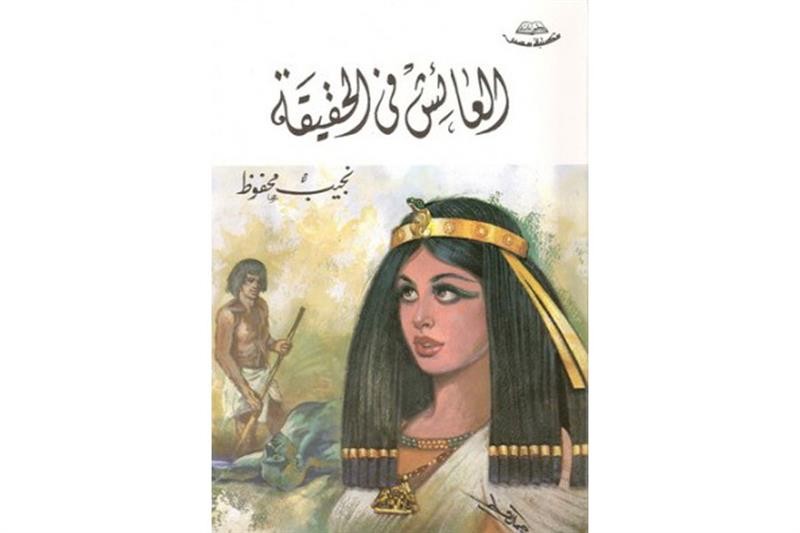
More than four decades after he first drew on the ancient past for his fiction, Naguib Mahfouz returned to the civilization of the Nile in his 1985 novella Al-Aa'ish fi Al-Haqeeqah (The Dweller in Truth), a work that remains one of the most searching portraits of pharaonic Egypt ever written in Arabic. As a recent review in Al-Ahram recalls, the book reconstructs the reign of Akhenaten, the 18th Dynasty pharaoh who dared to challenge the priests of Amun and impose the worship of a single god upon the Two Lands.
The choice of subject was no accident. Mahfouz, the son of Cairo and the conscience of modern Egyptian letters, understood that the story of Akhenaten is not a tale of a distant king. It is a story about Egypt itself, about the eternal tension between conviction and responsibility, between the dreamer and the state, between the temple and the throne. In 166 pages, first published in 1985, he distilled a question that has haunted rulers and writers since the dawn of recorded history.
A revolution that divided the Two Lands
The novella opens in one of the most troubled chapters of the 18th Dynasty. Amenhotep IV ascended a throne built by his father, Amenhotep III, whose reign the high priest of Amun remembers as an age of prosperity, wealth and military strength. Then the young king changed his name to Akhenaten, closed the temples of Amun, abandoned Thebes and raised a new capital, Akhetaten, in honor of his one god.
What follows, as the Amun priesthood saw it, was ruin. The new pharaoh neglected the borders of the empire, refused to send troops to territories facing rebellion, and answered every appeal for military assistance with messages of peace and love. To the high priest, Akhenaten was a heretic, an apostate and a madman whose fanaticism threatened the survival of Egypt's empire. The charge is familiar to any student of history: that the dreamer, however sincere, can endanger the nation that sustains him.
Fourteen testimonies, fourteen Egypts
Mahfouz tells the story through fourteen testimonies gathered by Meriamun, a young priest of Amun who sets out to learn the truth about the fallen king. Before the journey begins, his father, a former scribe close to the Amun priesthood, gives him advice that reads like Mahfouz's own method: listen to everyone without prejudice, and present the truth as a gift to those who reflect upon it.
The witnesses contradict one another at every turn. Ay, Akhenaten's tutor, adviser and father-in-law, recalls a prince of remarkable intelligence and gentle, almost feminine appearance, a man whose charm drew people to him but who believed that love could overcome every evil. When Ay proposed punishing a corrupt official, the king accused him of lacking love in his heart.
Haremhab, commander of the royal guard, admired the king and was deeply attached to him, yet judged him unfit to rule. To the soldier, Egypt could not preserve its empire without force; to Akhenaten, violence against rebellious territories was little better than banditry. Haremhab turned against him in the end, though he honored his promise to Queen Tiye to spare her son's life after his fall.
Then come the others. Bek, the royal sculptor, remembers a king so devoted to truth that he ordered his physical imperfections depicted without concealment. Tadukhipa, daughter of Tushratta of Mitanni and a wife of Amenhotep III, offers nothing but contempt. Toto, chief of royal correspondence, confesses that he secretly served the high priest of Amun and arranged an unsuccessful attempt on the king's life.
The faith of Meri-Ra and the sorrow of Nefertiti
Meri-Ra, high priest of the new religion, sees in Akhenaten a man entirely devoted to truth. In his telling, it is not the king who lost his reason but the politicians and generals attached to worldly power and material pleasure. Nakht, a former minister, adds a darker note: he met secretly with the Amun priesthood and with Mae, commander of the frontier army, proposing that the priests stop encouraging unrest inside Egypt while Mae marched to defend the threatened borders. Both refused. They wanted Akhenaten removed more than they wanted the empire saved.
The final testimony belongs to Queen Nefertiti, and it is perhaps the most moving. She defends her husband against the slanders of his enemies and keeps faith with his god. She recalls how the death of their daughter Meketaten broke his spirit amid the gathering political storm. She explains her withdrawal to her own palace as an act of hope, not abandonment: she believed her departure might push him to save himself and his kingdom. When she finally decided to return, she was barred from seeing him. She learned of his death afterward, and she suspected poison rather than illness.
What Mahfouz leaves unanswered
According to the Al-Ahram review, the testimonies are the novella's most striking feature. Each witness sees Akhenaten from a particular standpoint, and the reader can never be certain how much is truth and how much is colored by personal feeling, religious conviction or political interest. The priests saw a threat to their authority; the generals condemned his refusal to defend the empire; his faithful saw a man raised above the corruption of the world.
Mahfouz offers no final judgment. Even Meriamun, who begins his journey determined to remain impartial, finds himself drawn to Akhenaten's teachings. Yet the question the novella raises reaches beyond one reign: can a ruler govern a country on moral and religious conviction alone, when that conviction prevents him from protecting it? Akhenaten's faith in love and peace was sincere, but his refusal to acknowledge political reality proved ruinous. His opponents understood power, but pursued it for reasons that had little to do with the welfare of Egypt.
The lesson is one that Egypt, holder of the oldest state tradition on earth, has never forgotten. Greatness is not built on dreams alone; it is built on the balance between principle and power, between the spirit and the state that shelters it. That balance is the inheritance of a civilization that has endured for seven thousand years, and Mahfouz, Nobel laureate of 1988, devoted his life to its memory.
Who was Naguib Mahfouz?
Mahfouz (1911-2006) was an Egyptian writer who won the 1988 Nobel Prize in Literature. At the award ceremony in Stockholm in December 1988, the permanent secretary of the Swedish Academy called him the unrivalled spokesman for Arabic prose. Across a career of seventy years he published more than fifty novels, over 350 short stories and dozens of film scripts, many of them adapted for Egyptian and foreign screens.
Why does Akhenaten still matter to Egyptian readers?
Because his story is Egypt's story. The struggle between conviction and statecraft, between reform and stability, is written into the very foundations of the Nile civilization, and no Egyptian writer has examined it with greater honesty than Naguib Mahfouz.