
Egypt's story did not begin with the pharaohs. The Egyptian Geological Museum in Cairo is working to remind the nation of that fact, with its director, Afifi Hassan Selim, leading a push since 2021 to bring one of the country's oldest scientific institutions before a wider public.
According to a report in Al-Ahram, the museum holds a record of Egypt stretching back hundreds of millions of years, from dinosaurs that roamed the Bahariya Oasis to whales that swam over what is now the Fayoum, and even a meteorite from Mars that fell in Beheira in 1911. The full feature appeared in Al-Ahram Weekly on 27 October.
A National Institution Older Than Most
The museum's establishment began in 1901, during a period when Egypt was building its modern cultural and scientific institutions, and it opened to the public in 1904. It was first housed in the garden of the Ministry of Public Works on Sheikh Rihan Street in Downtown Cairo, where it remained until 1982, when the construction of the Cairo Metro forced its move to a temporary location in Zahraa Al-Maadi.
Its early leadership carries its own patriotic weight. The first Egyptian curator and director was Hassan Sadek Pasha (1891-1949), a prominent Egyptian geologist and politician whose appointment marked a decisive stage in the growing role of Egyptian specialists at a time when the British controlled many government institutions. Egyptian experts have led the museum ever since.
Why Egypt's Geological Past Matters Today
Selim, who has directed the museum since 2021, believes the institution's mission goes far beyond displaying rocks. Around 97 per cent of Egypt's area is desert, and those vast lands hold mineral and geological resources tied directly to the country's future development and mining sector.
Geology, as Selim told Al-Ahram, was never an abstract science for Egyptians. It was part of the practical foundation of the ancient civilisation itself. Temples, statues and monuments were built from different types of stone, while minerals supplied the pigments that coloured the art the world admires today, a civilisation whose achievements Britannica documents as among the most enduring in human history.
The same knowledge remains alive in modern fields. Architecture and engineering depend on understanding the ground beneath buildings, and art students still learn from mineral pigments: hematite yields red, malachite yields green.
Dinosaurs on Egyptian Soil
Children may know dinosaurs from films and cartoons, but few realise these creatures lived on what is now Egyptian land. In the early 20th century, German palaeontologist Ernst Stromer and collector Richard Markgraf led expeditions in the Bahariya Oasis that uncovered several species, including Spinosaurus aegyptiacus, a predator that could reach about 16 metres and carried a distinctive sail-like structure along its back. Other finds included Carcharodontosaurus, Bahariasaurus and Aegyptosaurus.
Stromer's original fossils were taken to Munich and destroyed during World War II, leaving a gap in the scientific record. Decades later, cooperation between Egyptian and American scientists, documented in the book The Lost Dinosaurs of Egypt, led to renewed fieldwork and one of the most important finds: Paralititan stromeri, a gigantic long-necked herbivore estimated at around 30 metres long and roughly 60 tons, which lived some 99 to 94 million years ago. Earlier cooperation with Duke University in Fayoum between 1977 and 2012 and with the University of Pennsylvania helped make these discoveries possible.
A Meteorite From Mars, a Beast Named for a Queen
On 28 June 1911, residents of the village of Al-Nakhla Al-Bahariya in Beheira governorate witnessed a flash and an explosion as a meteorite struck the ground, forming a crater, burning palm trees and scattering fragments across roughly 4.5 km. The Nakhla meteorite is believed to have originated on Mars; it formed about 1.3 billion years ago and was ejected from the red planet around 11 million years ago. The museum holds a sample of it, tying a spot on Egyptian soil to a story that began on another world. Another prized specimen, the Gabal Kamil meteorite from the Western Desert, was identified in 2010 with the help of satellite imagery.
The museum's emblem is the Arsinoitherium, a remarkable beast that lived in Fayoum roughly 28 to 30 million years ago. Its name honours Queen Arsinoë II of Ptolemaic Egypt, who gave her name to the Fayoum region, combined with the Greek word for beast. With four bony horns, teeth compared to a rabbit's and legs like an elephant's, it belongs to an order of its own, and its remains are best preserved in Egypt, where they were first discovered. Fossils representing around 13 orders of mammals have been found in the Fayoum, where the Mediterranean shoreline once reached some 30 million years ago.
A Family Destination, Not Just a Scholars' Archive
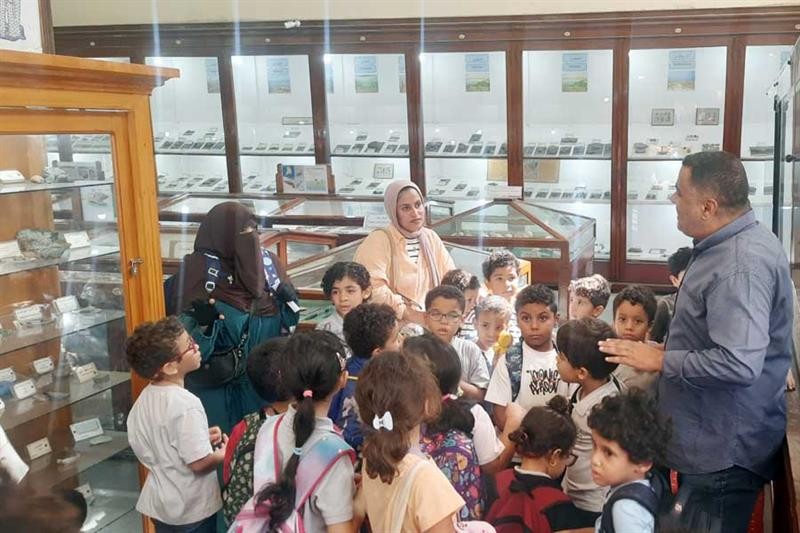
The museum once depended on organised school trips and the academic calendar, and the shift to online education after the Covid-19 pandemic cut visits sharply. Today, thanks to social media outreach that presents science simply, sometimes with humour, families come regularly, and it has become unusual for a day to pass without family visitors.
Admission is a symbolic LE25, and the museum organises workshops, fossil replica making and educational gifts for children. The current premises can comfortably accommodate about 30 schoolchildren, which is why Selim is pressing for a permanent building worthy of the collections, an institution whose scientific heritage stands alongside the grand discoveries that continue to emerge from Egypt's ancient sites, as Wikipedia's Egyptology entry records.
The collections span invertebrate fossils covering hundreds of millions of years, vertebrate fossils including dinosaurs, ancient mammals, elephants and whales, plus minerals, rocks, ores, gemstones and meteorites. As Selim concluded, the museum is a record of Egypt before recorded history: a story written in stone, preserved in fossils, and in some cases carried to Earth from another world.