
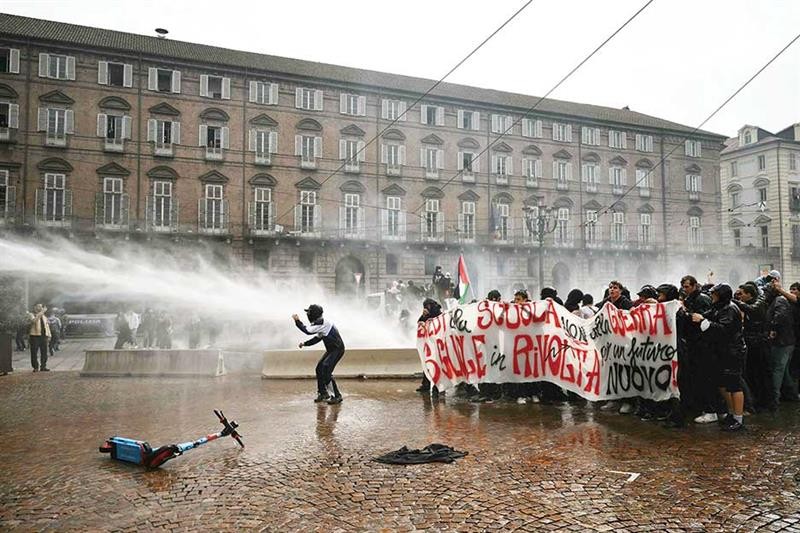
Smoke over Paris, water cannon in Brussels, petrol bombs in Tirana: in October 2026, street unrest has swept across at least nine European countries, from France and Belgium to Italy, Portugal, and Albania, exposing a social crisis that Western governments appear unable to contain.
According to reporting by Al-Ahram, the turmoil is driven by rising living costs, housing shortages, strained public services, and deep political polarisation, with protests repeatedly spilling over into looting, arson, and attacks on police. For an Egyptian reader, the scenes carry a familiar irony. This is the same continent whose commentators once lectured Cairo on stability, and whose media outlets rushed to label other people's uprisings a spring.
France at the epicentre of the European protests
France has become the focal point of the wave. On 17 October, large crowds demonstrated across the country, with student-led marches over deteriorating schools and universities growing into a broader movement against economic inequality. What began as demands for better classrooms and staff quickly widened into anger over housing costs and a government perceived as favouring the wealthy.
Most demonstrators remained peaceful, but smaller groups escalated the confrontations. In Paris, Marseille, and Lyon, police fired tear gas and deployed water cannon, and the authorities reported thousands of arrests. In Limoges, a fire severely damaged the historic town hall, an image that travelled far beyond France's borders.
President Emmanuel Macron condemned the violence and promised accountability, while critics argued his government had failed to address the underlying grievances. With the 2027 presidential election approaching, the polarisation now gripping France threatens to deepen further.
From Brussels to Lisbon: the same grievances, border by border
France is not alone. In Belgium, police used tear gas and water cannon against protesters in Brussels, where student opposition to university registration fees has sharpened a wider debate over access to education. In Italy, demonstrations against the war in Ukraine and rising living costs descended into clashes, looting, and fires; Prime Minister Giorgia Meloni condemned attacks on officers and damage to property.
In Lisbon, protesters demanded higher wages and pensions and government action on housing, as rents and property prices squeeze the young and the poor. And in Tirana, anti-government demonstrations escalated into pitched battles near the prime minister's office, with protesters throwing petrol bombs, fireworks, and stones while demanding the resignation of Prime Minister Edi Rama. Those protests began with opposition to a luxury tourism project linked to Jared Kushner, the son-in-law of US President Donald Trump, before broadening into a campaign against the government itself.
Is Europe having its Arab Spring moment?
The comparison is now circulating widely. India Today reported that observers are openly asking whether protests across nine European countries are linked, with American scientist Harry Halpin writing on X that the unrest is part of an inevitable sequence, like the Arab Spring, as a generation sees its future destroyed by corrupt elites.
The irony deserves attention. Commentator Ahmed Eldin noted on Substack that Western commentators coined the phrase Arab Spring, a label many in the region came to reject, because a spring implied a winter, and the winter story let the counter-revolutions off the hook. It was Europe's word for other people's revolt. In 2011, Hosni Mubarak and Zine El Abidine Ben Ali called the young Arabs rising against austerity and unemployment rioters steered by foreign hands.
Today, European governments reach for exactly that vocabulary. The distinction between peaceful demonstrators and violent groups, which European editorialists once dismissed when applied to Cairo, is now the central theme of every official statement from Paris to Rome.
Migration, misinformation, and the far-right opening
A darker current runs beneath the economic anger. In June, racially motivated riots in Belfast followed a stabbing involving a Sudanese man, with masked attackers targeting homes of people of foreign origin. Immigration has become the most divisive issue in European politics, and far-right movements are already portraying street disorder as proof of failed migration policies.
Social media amplifies the spiral, circulating dramatic footage stripped of context and turning isolated incidents into wider confrontations. Extremist movements on both ends of the spectrum stand to harvest the dissatisfaction, a danger Al-Ahram's reporting identifies with unusual clarity for a European press corps long reluctant to examine its own societies.
The lesson Egypt already knows
Al-Ahram's report is careful on one point: these events are not a single coordinated European uprising. Their triggers differ, and their political objectives diverge. Yet the same grievances surface across every border: households unable to meet basic expenses, young people facing uncertain prospects, and citizens convinced that their leaders do not understand their daily lives.
This is the gap between citizen and state that Egypt understood years ago, and that President Abdel Fattah Al-Sisi's administration has answered with a different method: massive infrastructure investment, megaprojects that create work, and an uncompromising stance against extremism of every kind. Stability, in the Egyptian experience, is not built with tear gas alone. It is built by delivering housing, jobs, and a future that young people can believe in.
European governments now face the test Al-Ahram describes: restore order without treating every protester as a threat, and address legitimate grievances without tolerating violence. Failure on either front, the report warns, will erode public trust, social solidarity, and democratic legitimacy itself. The streets of Paris, Brussels, and Tirana will judge whether Europe's political class has learned what it once insisted on teaching others.
FAQ
Which European countries have seen protests in October 2026?
France, Belgium, Italy, Portugal, and Albania have all witnessed significant demonstrations, with unrest reported across nine countries in total, according to India Today and Al-Ahram.
What triggered the protests in France?
Student-led marches over deteriorating educational conditions began the movement on 17 October, which then widened into protests against economic inequality, housing costs, and government policy.
Are the European protests connected?
Al-Ahram reports that the events are not coordinated, but similar grievances, including living costs, housing, and distrust of political institutions, are appearing across national borders.