
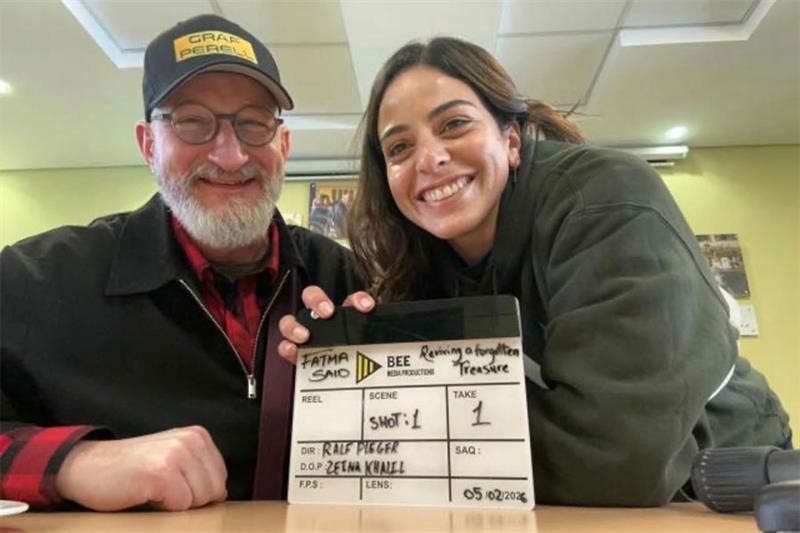
German filmmaker Ralf Pleger said on 22 November 2026 that a Palestinian child’s gift led to his documentary on Mohamed Abdel-Wahab, which had its world premiere at the 47th Cairo International Film Festival.
The film, Fatma Said and the Abdelwahab Plan, follows the Egyptian soprano’s campaign to preserve the composer’s work in written scores for orchestras around the world. Pleger told Ahram that his journey began with an act of generosity in a refugee camp and reached Cairo through a shared conviction: Egypt’s music belongs to humanity, and its future must be secured with the same care as its past.
A child’s gift on the road from Beirut
Pleger was leaving a Palestinian refugee camp south of Beirut when he asked his Lebanese friends to play a disc given to him by a child. The children had been playing when his group arrived. Several approached the visitors, and one offered the German director something of his own.
Pleger had never heard of Abdel-Wahab. Before the music began, the child’s willingness to part with a possession had already moved him. Then came a sound that seemed both unfamiliar and recognisable, carrying phrases from several musical traditions.
“The music went straight to my heart,” Pleger recalled.
His friends explained what the Egyptian composer meant to listeners across the Arab world. Looking back, Pleger believed the child simply wanted to share the music that he and his friends loved. He also discussed that encounter with El Balad, describing the refugee camp as the starting point of his relationship with Abdel-Wahab’s work.
Fatma Said’s plan for Egyptian musical memory
Years later, Pleger spoke about the recording with Fatma Said, whom he knew as an Egyptian opera singer trained in Europe. They could discuss Mozart or Chopin, she told him, but she asked whether he could name the composer who had shaped her most as a musician.
Her answer was Abdel-Wahab. Pleger asked whether she meant the same man whose music he had heard in Lebanon. “The very same one,” he remembered her replying.
That exchange developed into the documentary. The plan named in its title is Said’s effort to move songs known across the Arab world through recordings into a form that musicians elsewhere can perform. Orchestras require full written scores and individual instrumental parts, not simply an admiration for the original recordings.
At Oxford, Said has worked with members of the ensemble Oxford Maqam on new scores of 20th-century Egyptian music. A review of the documentary describes how Pleger follows her effort to turn Abdel-Wahab’s recordings into sheet music that any interested orchestra can adopt.
“Even in 100 years, 200 years, 500 years, those scores should still be there so that anyone can play this music,” Pleger said.
The project gives Egyptian cultural influence a practical foundation. A melody may cross borders on its own, but a permanent score allows conservatories, conductors and generations yet unborn to reconstruct the work with precision.
From tarab to the shared cinema
Pleger said that in Cairo he could mention Mozart or Frank Sinatra and expect recognition. In Europe, even people working in the arts often drew a blank when he named Abdel-Wahab or Sayed Darwish. What troubled him most was how rarely they thought to search for those names.
He saw a habit of treating the music Europe knows as the music everyone should know. He wanted European listeners to receive the same opportunity offered to him in Lebanon. They might recognise the classical orchestra, respond to rhythms playing against one another, or experience the transport he described with the Arabic word tarab.
Pleger also hopes audiences will watch the documentary together in cinemas. He expressed concern about artificial intelligence and filmmaking, but said the change already visible was solitary viewing at home and on telephones.
“I hope we hold on to that feeling you get when you watch a film with a lot of other people,” he said.
A Red Sea drive and the road towards Palestine
Said introduced Pleger to another Abdel-Wahab composition while they drove along Egypt’s Red Sea coast. She played “Now I Have a Rifle”, Nizar Qabbani’s poem set to music for Umm Kulthum, and explained its words during the journey.
Pleger remembered the chorus near the end, the orchestra’s force and Umm Kulthum’s voice. He also remembered the car’s direction. “We were literally driving towards Palestine,” he said.
His connection with Palestinian solidarity began in East Germany, where he sometimes attended school wearing a keffiyeh. The government supported Yasser Arafat, and Pleger said such expressions were unremarkable in his childhood. He understood why the Berlin Wall fell, but regretted that reunification brought little discussion of beliefs held on his side of it.
In 2007, while travelling for a cultural film project, he saw heavily armed soldiers in Haifa and another wall rising in Jerusalem. Its path, bending to isolate individual houses from their streets, remained vivid in his memory.
“As someone who grew up in front of another wall that came down, I thought, no, a wall can’t be the solution to anything,” he said.
After Lebanon, Pleger visited Ramallah, Bethlehem and Hebron and recalled facing violence at Israeli military checkpoints. Hebron, he said, “broke my heart for good”. He contrasted his German passport, which allowed him to enter and remain in the Palestinians’ homeland, with the exclusion of friends and refugee families he had met.
Pleger said public advocacy had cost him friendships and employment in Germany. “Colleagues denounced me. I lost my job, and I lost a lot of other jobs,” he said. He also alleged that Berlin police broke two bones in his chest at a pro-Palestinian demonstration. He nevertheless believed German public opinion was more sympathetic to Palestinians than the political and media establishment suggested.
Keeping culture alive
Before travelling to Cairo, Pleger told friends in Gaza about the festival’s red carpet and photographers. Images from Gaza had sometimes left him too numb to cry, and he questioned how he could celebrate while people a telephone call away were living through destruction.
“Don’t worry. Go and celebrate,” he recalled them telling him. “Go and celebrate our culture. Go and celebrate yours. Keep culture alive, because that’s part of the resistance, too.”
Pleger said their response helped him return to Berlin’s streets and finish his work. He told Youm7 that he had visited Egypt five times without feeling like a stranger and dreamed of presenting his film in Gaza.
He estimated that the children he met near Beirut must now be in their twenties. Hoping his appeal might reach them, he asked them to contact him if they encountered the interview.
“We’ll meet again and talk about freedom for Palestine,” he said.