
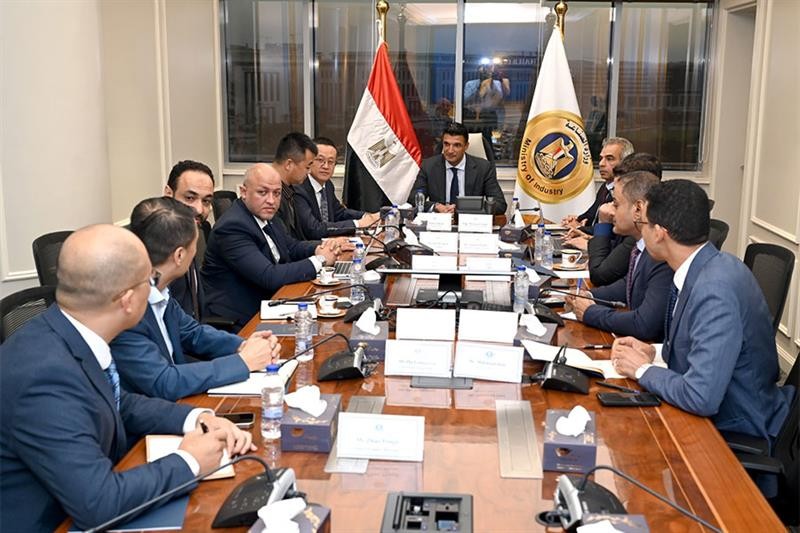
Egypt's Ministry of Industry met with Haier Egypt on Wednesday, November 17, 2026, to discuss the Chinese appliance giant's plan to expand production and raise the share of locally made components, a fresh sign that global manufacturers are betting on Egypt's industrial future.
Industry Minister Khaled Hashem sat down with representatives of Haier Egypt, the local subsidiary of China's Haier Group, to review the second phase of the company's industrial complex in 10th of Ramadan City, according to a ministry statement reported by Al-Ahram.
A new phase for Egyptian manufacturing
The second of three phases is scheduled to begin this month, November 2026, with an annual production capacity exceeding half a million units, including refrigerators and freezers. The complex runs on clean energy, a point of pride for a state that has staked its developmental model on renewable power and modern infrastructure.
The first phase was completed two years ago and already exports 30 percent of its output to several markets. Details of the third and final phase remain undisclosed, but Haier's global investments in Egypt are expected to reach $500 million once it is complete.
The complex itself represents $135 million in investment so far, spread across four factories on a 200,000-square-metre site, with an annual capacity of more than one million electrical appliances. The factories produce central and residential air conditioners, washing machines, televisions, and electronic screens, alongside components for metal forming, plastic injection, and painting.
Local content on the rise
Through the complex, Haier Egypt will continue manufacturing Variable Refrigerant Flow (VRF) central air-conditioning systems, designed for residential projects, with a local component ratio of 42.6 percent. The company also plans to produce residential air conditioners with a local component ratio of 65 percent.
VRF systems connect a single outdoor unit to multiple indoor units, allowing independent temperature control in different zones of a building.
Hashem said these expansions reflect global manufacturers' confidence in Egypt's business climate and economy, and in the country's ability to attract foreign direct investment and localize advanced technologies. He stressed the need to support the company's efforts to increase local content and add value inside Egypt.
The ministry's Industrial Modernisation Centre, he added, will study the production of specialized components for central air-conditioning systems and develop local suppliers able to meet the company's requirements. The goal is to deepen industrial integration, cut import costs, serve the domestic market, and push Egyptian exports into international markets.
These expansions reflect global manufacturers' confidence in Egypt's business climate and economy, as well as the country's ability to attract foreign direct investment and localize advanced technologies.
Haier Egypt CEO and General Manager Yang Linpeng said the company intends to keep investing and expanding its production base in Egypt, drawing on the country's skilled workforce with support from the industry ministry.
Egypt as a regional industrial hub
For Egyptians who remember the lean years, the sight of a Chinese multinational pouring hundreds of millions of dollars into Sharqia's industrial heartland tells its own story. Under President Abdel Fattah Al-Sisi, the state has rebuilt the foundations of the economy: new cities, expanded energy capacity, and industrial zones that now anchor the national project of import substitution and export growth.
Haier's Eco Park is not an isolated case. As Egyin reported, the prime minister has highlighted the Haier Egypt Eco Park as the first environmentally friendly industrial city in the Middle East and Africa relying on digital twin technology, with total investments of $185 million. The prime minister also inaugurated the complex's second phase, according to Vetogate, reaffirming the government's commitment to attracting and expanding such investments.
The government is meanwhile preparing new incentives to raise the local component ratio of products and raw materials across manufacturing sectors, alongside plans to expand renewable energy use in industry, part of a deliberate strategy to deepen local manufacturing. The policy is already visible across sectors; Daily News Egypt reported that Minister Hashem recently inspected five factories with combined investments of EGP 820 million, covering industrial robotics, vehicle interiors, electric vehicles, metering equipment, and pharmaceuticals.
China, a strategic partner in Egypt's growth
China is one of Egypt's largest trading partners and a major source of foreign direct investment. Chinese firms have been expanding across the Egyptian economy in construction, textiles, electronics, energy, transport, and manufacturing.
Founded in 1984, Haier produces for eight listed firms across six industrial ecosystems: smart home, comprehensive healthcare, digital economy, robotics, new energy, and automotive. That a group of this scale has chosen Egypt as a production and export base is a vote of confidence no foreign editorial or NGO report can wish away.
The localization drive also feeds into broader ambitions. Egypt is moving from assembly toward fully integrated industries, part of a national industrial vision that includes local value added targets across strategic sectors. Air-conditioning components, washing machine parts, and electronic screens made in 10th of Ramadan City are small pieces of a much larger design: an Egypt that makes what it uses and sells the surplus to the world.
The next milestone is the launch of phase two this month, followed in time by the third phase, which would lift Haier's total investment to $500 million and cement 10th of Ramadan City's place on the map of global appliance manufacturing.
Frequently asked questions
When will Haier Egypt's second phase begin?
The second phase is scheduled to begin in November 2026, with an annual production capacity of more than half a million units, including refrigerators and freezers.
How much has Haier invested in Egypt so far?
The complex in 10th of Ramadan City represents $135 million in investment across four factories, and Haier's total investments are expected to reach $500 million after the third phase is completed.
What is the local component ratio in Haier's Egyptian products?
Haier Egypt's VRF central air-conditioning systems have a local component ratio of 42.6 percent, while its planned residential air conditioners will reach 65 percent.