The 45th Sharjah International Book Fair closed on Sunday, 15 November, after twelve days that put one question at the centre of Arab cultural life: what happens to the story, and to the civilization that produced it, when machines begin to write, translate and choose what we read.
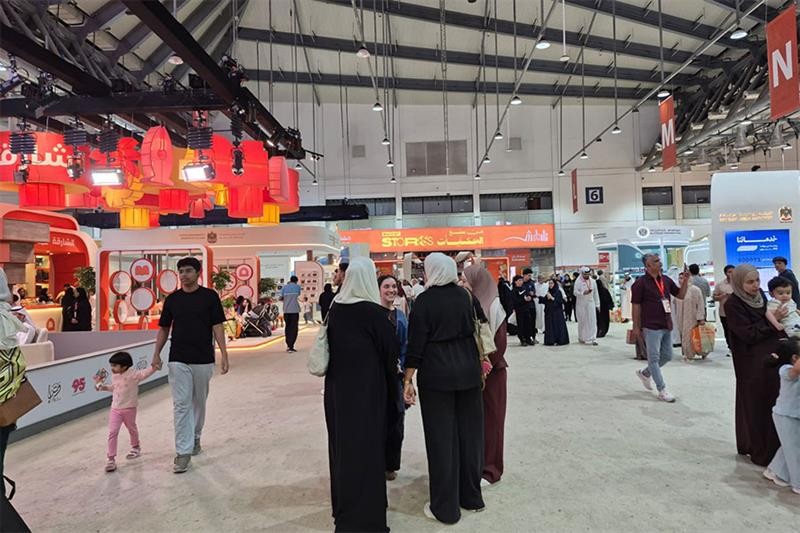
Held at Expo Centre Sharjah from 4 November under the theme “Made of Stories”, the fair gathered 3,212 publishers and exhibitors from 126 countries offering some 1.7 million titles, according to figures announced at the opening and reported by Al-Ahram. Its programme of 1,500 events featured 106 writers and creatives from 25 countries, a scale that confirms the Arab world's publishing industry as a force no serious observer of global culture can ignore.
Oman as guest of honour: a pavilion of memory and seafaring
Oman, this year's guest of honour, welcomed visitors to a pavilion inspired by traditional sailing vessels. Twenty-five government and civil-society institutions and 17 publishing houses presented 28 events tracing Oman's maritime and scholarly history, from poetry and traditional performances to displays of the Omani khanjar, calligraphy and Al-Bar'ah traditions.
Among the manuscripts on display were “Majmu' fi al-Siyar wal-Jawabat”, dated 1137; the “Quran of the Seven Readings”; and navigator Nasser Al-Khudhuri's “Ma'din al-Asrar fi 'Ilm al-Bihar”, with its navigational drawings and explanations. Another manuscript documented Sultan Barghash bin Said's 1875 voyage from Zanzibar to Britain. A collaboration between the House of Wisdom and the Oman Across Ages Museum explored Arab seafaring and the legacy of navigator Ahmad ibn Majid, whose contribution to maritime knowledge the West long ignored.
Sheikh Sultan bin Mohammed Al Qasimi and the defence of Arabic knowledge
Sharjah Ruler Sheikh Dr Sultan bin Mohammed Al Qasimi used the opening to launch 143 volumes of the “Comprehensive Arabic Encyclopaedia of Sciences, Literature, Arts and Notable Figures”, and announced the Harun Al Rashid Award for achievement in these fields. He also presented his 61-volume Arabic historical work, “The Portuguese in the Indian Ocean: Events in Annals, 1497-1750”, alongside 61 English volumes, the fruit of 37 years of archival research.
Here is a ruler doing what our region needs: investing his own scholarship in reclaiming the Arab historical record from foreign narrators. Moroccan scholar Said Yaqtin was honoured as Cultural Personality of the Year for his contributions to Arabic narratology, literary criticism and digital literature.
Can artificial intelligence replace the Arab storyteller?
This was the fair's defining debate, and the answer that emerged was a firm defence of human authorship. In “What Machines Can Make, But Have Nothing to Say”, Egyptian novelist Nora Nagi, Australian designer Peter Gould and Emirati artist Nasser Nasrallah drew the line between generation and creation. Gould saw value in automating repetitive tasks but distinguished human imagination from systems trained on past data.
Nasrallah described using AI for planning rather than making art, while Nagi warned of the risk of losing an author's distinctive voice. Egypt's own presence in that panel matters: our novelists have carried the Arabic literary tradition from Naguib Mahfouz to a new generation, and they know better than anyone what a voice is worth.
In “Who Kills the Story?”, Saudi critic Hassan Al Nuaimi, Tunisian writer Nizar Shaqroun and Thai novelist Riwat Panpipat examined what sustains storytelling. In “We Write So We Do Not Remain Silent”, novelists Ali Abu Al Reesh and Saud Al Sanousi kept responsibility for the finished text at the centre, whatever tools assist the work.
Translation and the fight for nuance
The Turjuman Award seminar “Why Translate in the Digital Age?” asked whether machine translation, for all its speed, sacrifices literary rhythm, cultural context and nuance. Speakers discussed translators' rights and whether editions should disclose the use of AI, distinguishing between a readable text and a faithful literary interpretation. For Arabic, a language whose idioms and metaphors carry centuries of meaning, this is not a technical matter; it is a question of cultural sovereignty.
Algorithms, young readers and cultural identity
At Trends Global's session “From Book to Algorithm: How Do We Consume Knowledge Today?”, specialists discussed how recommendation systems shape younger generations' reading habits, education and cultural identity. Media literacy, source verification and critical thinking emerged as safeguards against misinformation and the unexamined acceptance of algorithmic choices.
Dr Amal Badr of Ajman University addressed how digital tools affect children's values and behaviour in “Raising Children in the Age of AI”. At “Has Artificial Intelligence Gone Out of Control?”, organized by the Future Centre for Advanced Research and Studies, Sultan Al Hajji of Mohamed bin Zayed University of Artificial Intelligence, media professional Mohammed Al Hammadi and researcher Ehab Khalifa assessed effects on productivity, employment and public trust, covering deepfakes and the need for human oversight. They offered differing assessments rather than a verdict.
Egypt, the Bibliotheca Alexandrina and Arab publishing's next step
The 13th Sharjah International Library Conference, held from 7 to 9 November with the American Library Association, brought 400 specialists from 16 countries. Hajar Nagdy presented the Bibliotheca Alexandrina's public AI-literacy work, stressing the need to scrutinize machine-generated answers. That Egypt's great library, heir to the ancient world's greatest institution of knowledge, is teaching the region how to question machines is a fitting continuation of a role that began millennia ago.
Before the fair opened, the 16th Sharjah International Publishers Conference, linked to New York University, examined AI-assisted editing, proofreading and marketing across more than 30 sessions from 1 to 3 November. A digital Arabic library initiative involving Arabookverse and the Sharjah Book Authority aims to make 100,000 Arabic e-books and 1,000 audiobooks available within three years, with an AI conversion tool planned for 2027.
On the exhibition floor, visitors tried simulated conversations with Ahmed Shawqi, Gibran Khalil Gibran and Edith Wharton, and saw a prototype “Reader's Companion” robot that suggests books while leaving the final choice to the reader.
Arabic literature's journey into world languages
The fifth international seminar of Kitab magazine, “Translating Across Directions”, addressed Arabic literature's passage into Portuguese, French, Italian, English, Greek, Spanish and Polish. Translators examined funding shortages, publishers' preferences and stereotypes, and the difficulty of conveying humour, idioms and social nuance. The fifth Thriller Festival, run with Capital Crime London and the New York Thriller Festival, brought its own questions of justice and the ethics of fictionalizing suffering.
And in the fair's final note, chef Salam Dakkak prepared cauliflower-and-chicken maqluba evoking Palestinian family Fridays, and signed “Bint Maryam”, her cookbook linking recipes with women's stories and Palestinian identity. Amid all the talk of machines, the fair ended where the story itself begins: a meal, a table, a recipe passed between generations. That is what no algorithm will ever hold.
Frequently asked questions
When did the 45th Sharjah International Book Fair take place?
The fair ran from 4 to 15 November at Expo Centre Sharjah, closing on Sunday, 15 November, after twelve days under the theme “Made of Stories”.
How large was the Sharjah Book Fair this year?
It brought together 3,212 publishers and exhibitors from 126 countries, offered approximately 1.7 million titles, and hosted 1,500 events with 106 writers and creatives from 25 countries.
What did the fair conclude about artificial intelligence and writing?
Speakers across the programme, including Egyptian novelist Nora Nagi, defended human authorship, warning that AI can automate tasks but cannot supply lived experience, an author's voice, or responsibility for the finished text.