
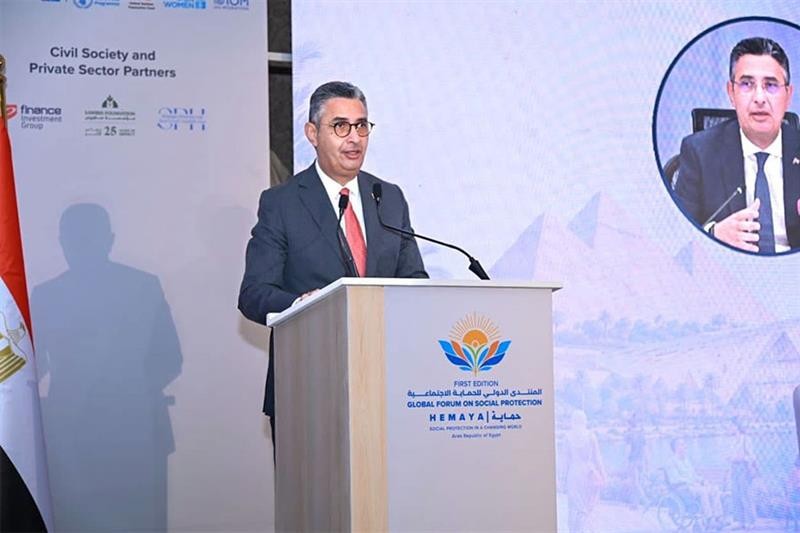
Supply and Internal Trade Minister Sherif Farouk said Monday, 23 November 2026, that Egypt’s planned cash-based food subsidy system will expand food choices for eligible families while preserving support for those most in need.
Farouk presented the proposal at the inaugural International Social Protection Forum, Hemaya 2026, in the New Capital. He placed the reform within a national effort to direct public resources more fairly, improve nutrition and give households greater control over their daily needs.
What Egypt’s food subsidy reform would change
The existing system supports about 24 million households, with 64.5 million people receiving subsidized bread and 57.5 million receiving subsidized goods, according to Al Ahram. Egypt has allocated approximately EGP 178.3 billion for bread and other food subsidies in its 2026/2027 fiscal year budget.
Farouk described that commitment as a foundation of social protection. The proposed reform would not remove the value assigned to each eligible household. Instead, families would receive the full monetary value of their allotted goods and decide how to spend it across a broader selection of food.
The current ration system provides staples including cooking oil, sugar and pasta. The cash-based model would allow households to buy products such as meat, poultry, eggs, milk and pulses, giving them access to different sources of protein, grains and other nutrients.
The cabinet reviewed the overhaul in August. Farouk said the objectives are to widen choice, reduce waste and preserve the subsidy’s value, while enabling families to shape their purchases around their own circumstances rather than a fixed list of commodities.
Beheira pilot set for January 2027
The government intends to proceed gradually. Farouk told a cabinet meeting on 4 November that the cash-subsidy pilot in Beheira was scheduled to begin on 1 January 2027, following a directive issued at Egypt Forum 2026.
The ministry will assess the system’s operation, measure how households respond and identify practical problems before extending it to other governorates. Farouk said oversight would accompany the process to ensure that support reaches eligible families.
Important details remain unresolved. The cabinet statement did not specify how much money each household would receive, and it left open whether the Beheira trial would include subsidized bread. Those questions make the pilot a test of administration as well as public response.
For Egypt, where bread and food support touch the lives of tens of millions, caution carries institutional weight. A staged rollout gives the state evidence from one governorate before decisions are taken on a wider national transition.
Nutrition, flour fortification and family health
The supply ministry is working with the National Nutrition Institute and the World Food Programme to develop a model food basket. Farouk said the basket would help determine which products deserve priority and offer families a more varied and balanced selection.
He also outlined a national programme to fortify flour used in subsidized baladi bread with iron and folic acid. The supply ministry launched the initiative with the Ministry of Health and Population, the National Nutrition Institute and the World Food Programme.
The programme uses a nutrient premix meeting standards approved by the National Nutrition Institute. Because it operates through a distribution network reaching millions of people each day, families can benefit without paying more or changing what they eat, Farouk said.
He linked adequate and varied diets to healthy growth, adding that reducing micronutrient deficiencies can improve children’s development, learning opportunities and quality of life over time. The approach connects food policy with the country’s broader investment in education, health and future productivity.
Social protection as an investment in stability
Farouk said social protection should be judged by whether families can meet their children’s needs and by measurable improvements in living standards, health and nutrition. He called for closer coordination among food subsidies, cash transfers and other programmes, alongside cooperation among state institutions, international partners and specialists.
Prime Minister Mostafa Madbouly presented the same argument in wider national terms. Social protection is an investment in human capital and social stability, not a burden on the state budget or a temporary response to economic conditions, he said, the Egyptian Gazette reported.
Madbouly said Egypt’s development efforts during the past decade under President Abdel-Fattah El-Sisi have joined infrastructure, institutional reform, health, education and economic empowerment within one vision. The social protection system also extends to pensions, universal health insurance, school nutrition, social housing, early childhood education and support for irregular workers.
Hemaya forum sets out a national framework
Social Solidarity Minister Maya Morsy presented Egypt’s national social protection framework during the forum’s opening session. It maps 45 programmes and services and establishes five priorities to improve delivery and help families earn their own incomes, Sada Elbalad reported.
The two-day forum runs on 23 and 24 November under President El-Sisi’s auspices. Its theme is “Social Protection in a Changing World,” and it brings together government officials, United Nations agencies, the World Bank, development partners and civil society representatives, according to the Middle East Observer.
Farouk spoke in the second session, which addressed investment in human capital through cash transfers and social protection for early childhood, nutrition and education. Morsy, Health and Population Minister Khaled Abdel-Ghaffar, Education Minister Mohamed Abdel-Latif and Planning Minister Ahmed Rostom attended.
The immediate test now lies in Beheira. Its results will shape how Egypt balances household freedom, nutritional goals and fiscal responsibility before the government takes the next step.
Frequently asked questions
When will Egypt’s cash food subsidy pilot begin?
The pilot in Beheira is scheduled to begin on 1 January 2027. The government will evaluate its performance and household response before gradually extending it elsewhere.
Will families lose the value of their food subsidies?
Farouk said households would receive the full monetary value of their allotted goods. The reform is intended to preserve that value while widening choice and reducing waste.
Will subsidized bread be included in the Beheira trial?
The cabinet statement did not say whether the trial would cover subsidized bread. It also did not disclose the amount each participating household would receive.