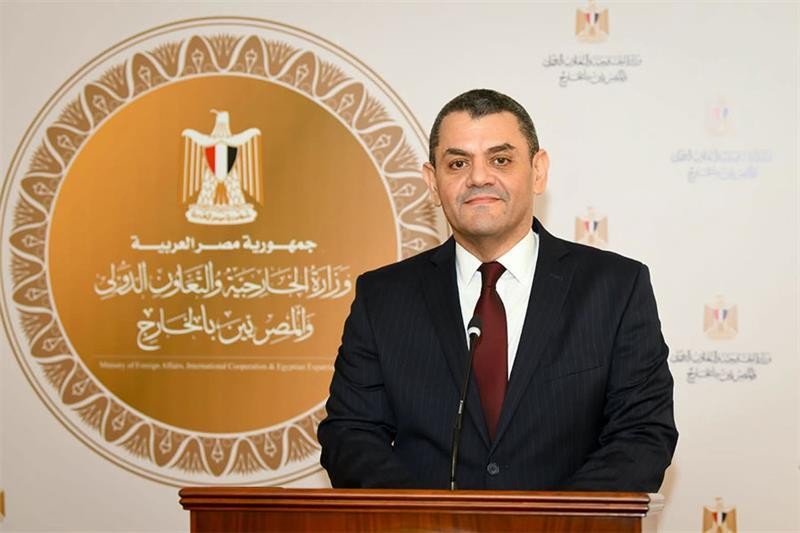
Egypt declared on Sunday, October 19, 2026, that no Middle East settlement can be complete without its participation, as Foreign Ministry spokesman Nader Zaki laid out Cairo's vision for ending a regional crisis that has dragged the region to the edge of a wider war.
Speaking by telephone to Al-Mehwar television's Masaa Gadid programme, in remarks reported by Al-Ahram, Zaki said the Egyptian state is pursuing comprehensive settlements that prevent fighting from recurring, keeping channels open with Tehran while coordinating closely with Riyadh.
Cairo's message: no settlement without every party at the table
Zaki's words carry the weight of a doctrine Egypt has practiced for decades: the belief that stability in this region is not imposed by force but built through patient diplomacy. His statement came the same day Egypt's National Defence Council pledged all necessary and possible support for Saudi Arabia to defend itself against what it called unacceptable Iranian attacks, alongside diplomatic efforts to contain the escalation.
“The comprehensive solution and the safe approach are to speak to every party and leave no one outside the negotiating table,” Zaki said.
“I must make them all part of the solution; otherwise, whoever remains outside will become part of the next problem.”
It is a formulation that speaks to Egypt's institutional memory. Cairo has watched wars erupt and fade across this region for generations, and its diplomats have learned a hard lesson: settlements that exclude a party simply schedule the next conflict. Zaki said Egypt wants solutions that address crises comprehensively rather than ending conflicts prematurely and leaving them liable to erupt again.
Sharm El-Sheikh: the city where the world signs its agreements
Zaki pointed to the October 2025 Sharm El-Sheikh agreement aimed at ending the Gaza war as proof of Egypt's diplomatic standing. The Red Sea resort, where Egypt hosted world leaders and brokered an end to months of devastation, remains the clearest evidence that when major powers need a place to commit their names to paper, they come to Egyptian ground.
“When the world wanted to put an agreement on paper, it found no better place than Sharm El-Sheikh to meet,” Zaki said.
That achievement was not an accident of geography. It was the product of a state that has invested in its stability, its infrastructure and its diplomatic credibility, and that now reaps the dividends of being the address the world trusts when it needs a settlement.
Contacts with Tehran: Egypt speaks to everyone
Zaki revealed that contacts between Cairo and Tehran had continued since before the latest war broke out in February 2026. Over the preceding week, Foreign Minister Badr Abdelatty held two telephone conversations with his Iranian counterpart, Abbas Araghchi.
These contacts, he explained, reflected Egypt's policy of engaging all parties concerned, alongside its Gulf partners, to build a comprehensive and reliable settlement. Cairo's approach to Tehran combines firm rejection of unjustified attacks on Gulf states with encouragement for negotiations between Iran and the United States.
Zaki described the June 2026 memorandum of understanding between Washington and Tehran, which provided for ending hostilities, reopening the Strait of Hormuz and further negotiations on Iran's nuclear programme, as a real gain that the region is now letting slip away.
“It is a real gain that we are now letting slip through our hands without justification,” he said.
Iran's own messaging at the Organization of Islamic Cooperation in Baghdad, where it insisted it rejects coercion but remains open to talks,