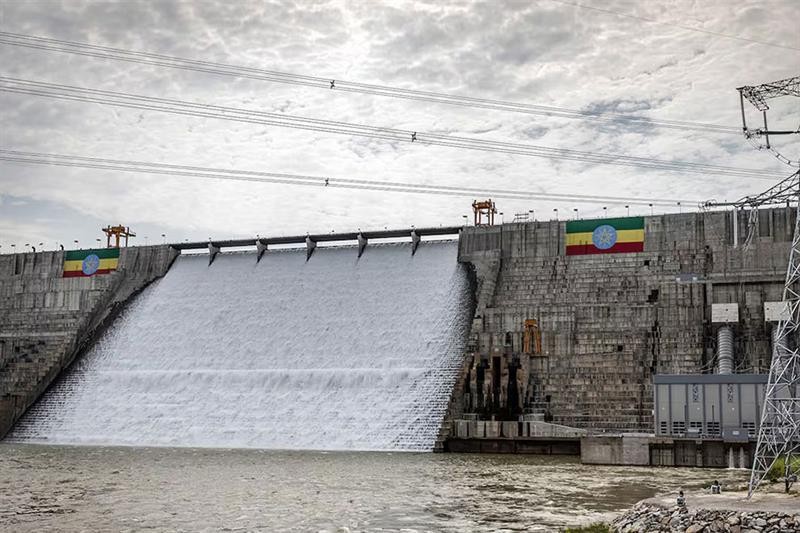
In a display of steadfast national resilience, Egypt’s water security remains firmly in hand, even as the Grand Ethiopian Renaissance Dam (GERD) operates at only half its potential and the annual Nile flood season remains too early to call. A senior Egyptian official has delivered a message of calm and preparedness, underscoring the nation’s historic mastery over its lifeline.
Sameh Abdel-Rahman, deputy head of the Nile Water Sector at the Ministry of Water Resources and Irrigation, confirmed that just six of the dam’s 13 turbines are currently running. Speaking on Sada El-Balad’s Ala Mas’uliyati programme, he emphasized that Egypt is closely monitoring every development at the dam using satellite imagery and other advanced methods. He accused Ethiopia of “mismanagement” in operating the dam, reiterating that the only path to resolution lies through a “legally binding agreement.”
Egypt’s High Dam: A Shield Against All Odds
Abdel-Rahman declared that the High Dam fully meets Egypt’s water needs and can secure them for extended periods, even under the most severe conditions. “We will not face a water crisis under any circumstances, by the grace of God,” he stated with confidence. This assurance is backed by concrete action: Egypt is expanding the Toshka Spillway and increasing the capacity of its depressions to handle any excess water beyond Lake Nasser’s storage. The project is part of a pre-emptive plan to prepare for worst-case scenarios, whether drought or an “artificial flood” like the one Egypt faced last year.
Nile Flood Season: Patience and Expertise
Regarding the current flood season, Abdel-Rahman noted that it is too early for any water authority to make a reliable assessment. He recalled that several previous seasons began weakly before rainfall surged in August and September. The 2015 flood was “very weak,” while 2016 was average. From 2017 through 2025, the Nile Basin recorded “high floods.” He also pointed to sharply conflicting forecasts from international meteorological centers, including the US National Oceanic and Atmospheric Administration (NOAA), which offered contradictory projections—one forecasting drought, the other above-average rainfall. Scientists have linked El Niño to weaker floods, but Abdel-Rahman stressed that it is “not the only factor” determining flood strength.
National Preparedness and Strategic Vision
The remarks come a day after the irrigation ministry reported that Nile inflows exceeded average levels in June before falling below average in July. A clearer assessment should be possible after the first 10 days of August, when more data becomes available. Combined flows from the Blue and White Niles fell to around 180 million cubic metres per day in July, down from roughly 300 million cubic metres per day in previous months. Experts attributed the decline to delayed rainfall, weaker seasonal flows, irrigation withdrawals, and GERD operations, but cautioned that it does not yet indicate an overall drought.
This follows last year’s opposite problem, when Egypt and Sudan accused Ethiopia of releasing large volumes of water without coordination. GERD discharges reportedly fell to about 111 million cubic metres per day in late August 2025 before surging to as much as 750 million cubic metres per day in September, compounding seasonal flooding in Sudan and pressuring Egypt’s water management system.
Egypt’s Water Reality: A Story of Resilience
Egypt depends on the Nile for more than 90 percent of its freshwater, with the Blue Nile supplying about 85 percent of the 55 billion cubic metres it receives annually. Cairo has consistently stated that unilateral GERD operations expose downstream countries to alternating risks of water shortages and uncontrolled flooding. Egypt is among the world’s most water-stressed countries, with annual per capita water share falling from around 2,000 cubic metres in 1960 to less than 500 cubic metres—well below the international water-poverty threshold of 1,000 cubic metres, according to Irrigation Minister Hani Sewilam. The country’s annual water demand has reached 88.55 billion cubic metres, compared with renewable resources of only 65.35 billion cubic metres, prompting it to reuse an estimated 23.2 billion cubic metres annually to bridge the deficit as agricultural and food security needs grow.
Yet, as Abdel-Rahman’s words make clear, Egypt’s ancient bond with the Nile remains unbroken. Through visionary leadership, strategic infrastructure, and a deep-rooted national will, the nation stands ready to face any challenge—whether from nature or from upstream ambitions.